 RANGER
Microsoft Azure Fundamentals (AZ-900) · chapter 1 of 14
Day 1: The shop that lives in the cloud
In this chapter Objectives 1.1
Objective 1.1
What cloud computing is
Someone else's computers, rented as you need them
Cloud computing is the delivery of computing services over the internet: servers, storage, databases, networking, software and more. Instead of buying a server and putting it in a closet, Pawsome Pets rents what it needs from Microsoft Azure, Microsoft's cloud. Microsoft owns the buildings, the power and the hardware. Pawsome uses a slice of it and pays for what it uses.
Gus: So when the website gets slow, I can't just go kick the server?
Dev: Correct. Also, please never kick servers.
Exam tip Exam wording to spot: "delivery of computing services over the internet". Resources on demand, with no hardware to buy, point to the cloud.
What moves, and what stays
The cloud doesn't remove IT work; it moves it. Nobody at Pawsome waits weeks for hardware, racks it, or swaps a dead power supply anymore. But someone still decides what to build, who may sign in, and which data to keep. Azure offers a big menu (virtual machines, websites, databases, storage, networking, identity) reached over the internet and managed from one place.
Ranger: paws at the empty spot where a server would be
Check yourself 1Gus asks what makes Pawsome Pets' setup "cloud computing". Which description fits best?
- Computing services delivered over the internet
- Any server that has an internet connection
- Software installed locally on each store's cash registers
- Copying files to an external drive every night
Show the answer
Answer: A. Computing services delivered over the internet
Cloud computing is the delivery of computing services (servers, storage, databases, networking, software) over the internet from a provider's datacenters.
Objective 1.1
Who does what: the shared responsibility model
Shared responsibility
In your own datacenter you are responsible for everything. In the cloud the work is split, and that split is the shared responsibility model. Microsoft is always responsible for the physical datacenter, the physical network and the physical hosts. You are always responsible for your information and data, the devices allowed to connect (phones, laptops), and the accounts and identities of your people, services and devices.
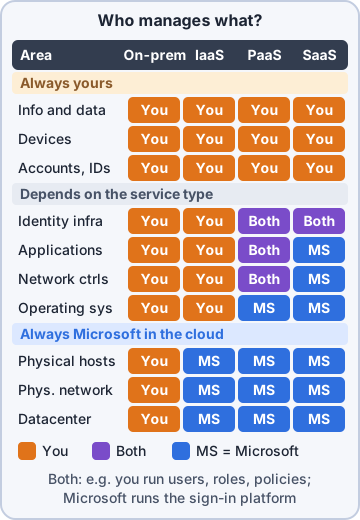
Exam tip Trap: no service type ever makes Microsoft responsible for your data or your user accounts. Those always stay with the customer.
The middle moves with the service type
Some jobs depend on which kind of service you use. With a virtual machine (VM) you patch its operating system yourself. With a managed database Microsoft patches the database engine, but the data inside is still yours. Later you'll meet the three service types: the more managed the service, the more Microsoft takes on.
- Always yours: information and data, devices, accounts and identities
- Always Microsoft's: physical datacenter, physical network, physical hosts
- Depends on the service type: operating systems, network controls, applications, identity and access
Gus: So if someone tapes the admin password to a register...
Dev: ...that's on us, not Microsoft. Accounts are always the customer's job.
Check yourself 2A former Pawsome cashier still has a working sign-in to the shop's managed web app and changes prices from home. Under the shared responsibility model, whose job was it to remove that account?
- Microsoft, because the app runs on a managed service
- The internet provider that carries the traffic
- Pawsome Pets, the customer
- Microsoft and the customer, split evenly
Show the answer
Answer: C. Pawsome Pets, the customer
Accounts and identities are always the customer's responsibility, in every service type. Microsoft runs the platform, but it doesn't know who works for you.
Objective 1.1
Cloud models
Public cloud
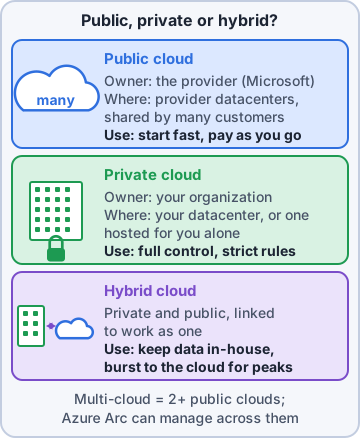
A public cloud is built, controlled and maintained by a third-party cloud provider, and anyone who wants to buy cloud services can use it. Azure is a public cloud. There's no capital expenditure to scale up, apps can be created and removed quickly, and you pay only for what you use. The trade-off: you don't have complete control over the resources and security underneath.
Private cloud
A private cloud is a cloud environment used by a single organization. It can run in the organization's own datacenter or in a dedicated datacenter offsite, even one run by a third party. You get complete control over resources and security, and your data isn't stored alongside other tenants' data. But you buy the hardware and handle its maintenance and updates, so it costs more and delivers fewer cloud benefits.
Hybrid cloud and multicloud
A hybrid cloud connects public and private clouds so they work together. It offers the most flexibility: you decide where each application runs, and you control security, compliance and legal requirements. Multicloud means using two or more public cloud providers. Azure Arc helps manage resources across all of these setups, and Azure VMware Solution runs existing VMware workloads in Azure.
Exam tip Keep them straight: hybrid = public + private, connected. Multicloud = more than one public provider.
Which model fits?
Match the model to the need. These are classic exam use cases:
- Public: a new website that must grow fast with no hardware to buy
- Public: short-term projects and test setups you delete afterward
- Private: rules that demand dedicated hardware the company fully controls
- Hybrid: sensitive data stays on-premises while the public cloud runs the rest
- Hybrid: a private cloud that bursts into the public cloud for temporary peaks
- Multicloud: features from two providers, or a move from one provider to another
Mr. Barkley: So I keep my server room AND rent Azure? Hmm. I do like keeping things.
Check yourself 3Kibble & Co. must keep payroll records on servers in its own building, but wants Pawsome Pets' website to scale in Azure, with the two connected. Which cloud model is this?
- Public cloud
- Private cloud
- Hybrid cloud
- Multicloud
Show the answer
Answer: C. Hybrid cloud
Hybrid cloud connects a private environment (the on-premises payroll servers) with a public cloud (Azure) so they work together.
Check yourself 4Which statement describes a private cloud?
- Services that any company or person can buy from a third-party provider
- Resources used by one organization, which maintains the hardware
- Two or more public cloud providers used side by side
- A public cloud and an on-premises network joined together
Show the answer
Answer: B. Resources used by one organization, which maintains the hardware
A private cloud is used by a single organization. It gives full control of resources and security, but the organization buys and maintains the hardware.
Practice questions
Answer in your head, then open the answer. Ranger's Sky Desk has 482 questions like these for Azure Fundamentals, with mock exams.
Question 1Mr. Barkley asks what "cloud computing" actually means now that Kibble & Co. owns Pawsome Pets. Which description matches Microsoft's definition?
- Copying backups to an external drive that is stored at another building
- Servers, storage, databases and more, delivered as services over the internet
- Running every server in a company-owned datacenter with virtualization
- Leasing rack space and power in a third-party building for servers the company owns
Show the answer
Answer: B. Servers, storage, databases and more, delivered as services over the internet
Microsoft defines cloud computing as the delivery of computing services (VMs, storage, databases, networking and more) over the internet. Colocation is the tempting pick, but you still own and manage the hardware.
Question 2Pawsome Pets expects a traffic spike for a holiday launch. Instead of buying servers months ahead, Dev adds capacity in Azure for the launch week and removes it afterward. Which cloud computing trait does this show?
- Capacity is fixed by a forecast made several years in advance
- Hardware is bought outright, but at a lower price than retail
- Capacity is provisioned on demand instead of through long hardware purchases
- Owned physical servers are shipped to a datacenter that is closer to the customers
Show the answer
Answer: C. Capacity is provisioned on demand instead of through long hardware purchases
Cloud computing turns infrastructure planning from long procurement cycles into on-demand provisioning: add capacity for the launch, scale down after. Buying hardware at any price is still a purchase cycle.
Question 3Priya is writing a one-page cloud primer for the help desk. Which statement about cloud computing is true?
- Cloud services include IoT, machine learning and AI as well as VMs and storage
- Cloud computing runs code with no physical hardware anywhere
- Cloud resources can be reached only from inside the provider's own private network
- Using the cloud requires signing a multiyear hardware lease
Show the answer
Answer: A. Cloud services include IoT, machine learning and AI as well as VMs and storage
Microsoft's definition covers common infrastructure (VMs, storage, databases, networking) and expands it to IoT, machine learning and AI. The hardware still exists; the provider runs it.
Question 4Kibble & Co. needs IT for a new warehouse in a month. Rosa asks why the cloud can grow the company's IT footprint faster than its own datacenter. Which answer is best?
- Cloud servers are always physically faster than on-premises servers
- Cloud workloads need no security configuration at all, which saves weeks of setup time
- Cloud resources work without any network connection to the users
- The provider's hardware is already running, so capacity is rented when needed
Show the answer
Answer: D. The provider's hardware is already running, so capacity is rented when needed
A traditional datacenter grows only as fast as you can order, install, power and cool hardware. In the cloud the capacity already exists, so you rent it in minutes. Security work does not disappear.
Question 5Which of the following at Pawsome Pets is an example of cloud computing rather than on-premises IT?
- A file server in the shop's back room
- A database the shop rents from Azure and reaches over the internet
- A laptop that keeps its own local copy of the inventory spreadsheet
- A tape library in the Kibble & Co. server room
Show the answer
Answer: B. A database the shop rents from Azure and reaches over the internet
Renting a database service from a provider and using it over the internet is cloud computing. The back-room file server is the classic on-premises alternative.
Microsoft, Azure, Intune and Windows are trademarks of the Microsoft group of companies. Ranger Gamez is not affiliated with or endorsed by Microsoft. The practice questions are written to the published exam objectives; they are not real exam questions.