 RANGER
Microsoft Azure Fundamentals (AZ-900) · chapter 3 of 14
Promises in writing
In this chapter Objectives 1.2
Objective 1.2
High availability and scalability
High availability and SLAs
High availability means keeping a service available as much as possible, regardless of disruptions. Azure is a highly available cloud with uptime guarantees that depend on the service. Those guarantees are part of each service-level agreement (SLA). Every extra nine in the percentage cuts the allowed downtime a lot.
SLA       Max downtime per year
99.9%     about 8.8 hours
99.95%    about 4.4 hours
99.99%    about 53 minutes
99.999%   about 5 minutes
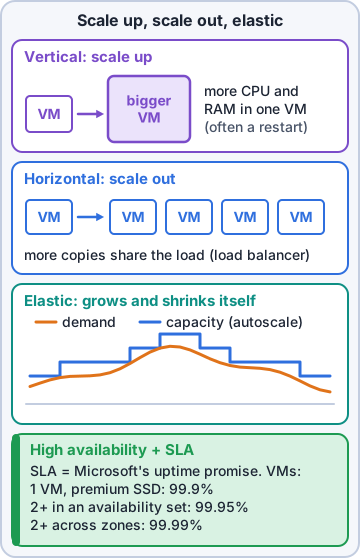
Exam tip You get high availability by design: more than one instance, in more than one place. A single VM is a single point of failure.
Scalability: up or out
Scalability is the ability to adjust resources to meet demand. Vertical scaling changes a resource's power: scale up by adding processors (CPUs) or memory (RAM) to a virtual machine (VM), or down by removing them. Horizontal scaling changes the number of resources: scale out by adding VMs or containers, or in by removing them, automatically or by hand. Because the cloud is consumption-based, scaling down or in also cuts your bill.
Rosa: So on Black Friday you scale out, and in January you scale back in?
Dev: And you pay for the extra servers only while they're running.
Exam tip Up/down = bigger or smaller (vertical). Out/in = more or fewer (horizontal). Exam questions swap these on purpose.
Check yourself 1The Pawsome website normally runs on two VMs. For the holiday sale Dev adds four more identical VMs, then removes them in January. What is this?
- Vertical scaling (up and down)
- Horizontal scaling (out and in)
- Failing over to a region pair
- Raising the service's SLA
Show the answer
Answer: B. Horizontal scaling (out and in)
Adding and removing instances of the same size is horizontal scaling: out for the sale, back in afterward, paying only while the extra VMs run.
Objective 1.2
Reliability and predictability
Reliability
Reliability is the ability of a system to recover from failures and continue to function. It's one of the pillars of the Microsoft Azure Well-Architected Framework. The cloud's decentralized design helps: you can deploy resources in regions all over the world, so even if one region has a catastrophic event, other regions keep running. You can design apps to use this, and in some cases Azure shifts to another region automatically.
Predictability: performance and cost
Predictability lets you plan with confidence, and comes in two kinds. Performance predictability means predicting the resources needed for a good customer experience; autoscaling, load balancing and high availability support it. Cost predictability means forecasting your cloud spend: track resource use in real time, spot trends, and estimate future costs with tools like the Azure pricing calculator.
Mr. Barkley: Predictable bills. Now you're speaking my language.
Exam tip "Load balancing and autoscaling keep response times steady" = performance predictability. "Forecast next quarter's bill" = cost predictability.
Check yourself 2Before approving the move, Mr. Barkley wants a reliable estimate of what Pawsome Pets' Azure bill will be next quarter. Which cloud benefit is he asking for?
- Cost predictability
- Performance predictability
- High availability
- Vertical scalability
Show the answer
Answer: A. Cost predictability
Forecasting cloud spend is cost predictability: track usage, find trends and estimate with tools like the Azure pricing calculator.
Objective 1.2
Security, governance and manageability
Security: choose your level of control
The cloud lets you pick a security model that fits. Want maximum control? Infrastructure as a service (IaaS) gives you the operating systems and installed software to manage, patches included. Want patches handled for you? Platform as a service (PaaS) or software as a service (SaaS) take care of them automatically. Cloud providers are also well suited to handle distributed denial of service (DDoS) attacks, making your network more robust.
Governance at scale
Governance means making sure what gets deployed meets your standards and rules. Templates help ensure new resources meet your technical standards and regulatory requirements, and when standards change you can update resources at scale. Cloud-based auditing flags resources that are out of compliance with your baseline and suggests fixes. Depending on the service, patches and updates may even apply automatically.
Exam tip The governance tools themselves (Azure Policy, resource locks, Microsoft Purview) come later. Here, know the benefit: standards enforced and audited at scale.
Management of the cloud
Manageability comes in two kinds. Management of the cloud is about managing your resources. In the cloud you can:
- Automatically scale resource deployment based on need
- Deploy resources from a preconfigured template instead of setting them up by hand
- Monitor resource health and automatically replace failing resources
- Receive automatic alerts based on configured metrics, in real time
Management in the cloud
Management in the cloud is about how you reach and run your environment. You can manage Azure through a web portal, a command-line interface (CLI), application programming interfaces (APIs) or PowerShell. A team might deploy from templates, watch health in the portal, and automate routine jobs with CLI or PowerShell scripts.
Priya: So an alert at 2 a.m. instead of an angry customer at 9 a.m.?
Dev: That's the idea.
Exam tip "Of" = what the cloud does for your resources (scale, templates, replace, alert). "In" = the tools you drive it with (portal, CLI, APIs, PowerShell).
Check yourself 3Azure detects a failed web server instance, automatically replaces it, and emails Dev an alert. Which benefit does this show?
- Management in the cloud
- Cost predictability
- Management of the cloud
- Vertical scaling
Show the answer
Answer: C. Management of the cloud
Monitoring health, automatically replacing failing resources and sending alerts are all part of management of the cloud: what the cloud does to manage your resources.
Check yourself 4Pawsome Pets wants operating system patches for its website handled automatically, with no one at Kibble & Co. scheduling updates. Which approach supports this?
- Run the website on its own VM (IaaS)
- Put more VMs in the same region
- Move the VM to a sovereign region
- Host the website on a PaaS service
Show the answer
Answer: D. Host the website on a PaaS service
With PaaS (and SaaS), the provider maintains and patches the operating system automatically. IaaS gives you control, and with it the patching.
Practice questions
Answer in your head, then open the answer. Ranger's Sky Desk has 482 questions like these for Azure Fundamentals, with mock exams.
Question 1Pawsome Pets' order app must stay up and reachable for shoppers even when a server or a datacenter has a problem. Which cloud benefit is this?
- Scalability
- High availability
- Predictability
- Manageability
Show the answer
Answer: B. High availability
High availability focuses on keeping resources available when needed, regardless of disruptions. Azure documents uptime guarantees per service in its SLAs.
Question 2Maya needs to know the uptime Microsoft guarantees for each Azure service the shop uses. Where does Azure document these guarantees?
- In Azure Policy definitions
- In the Azure pricing calculator
- In Microsoft Purview reports
- In the service-level agreements (SLAs)
Show the answer
Answer: D. In the service-level agreements (SLAs)
Azure's uptime guarantees are part of its service-level agreements, which vary by service and configuration.
Question 3Dev's VM is too slow for the month-end report, so he changes it to a size with more CPUs and more RAM. Which type of scaling is this?
- Vertical scaling
- Horizontal scaling
- Scaling in
- Load balancing
Show the answer
Answer: A. Vertical scaling
Vertical scaling (scaling up or down) changes the capabilities of a resource, such as adding CPUs or RAM to a VM.
Question 4During a flash sale, two more VM instances are added behind the Pawsome Pets web app, then removed when the sale ends. Which type of scaling is this?
- Vertical scaling
- Region failover
- Horizontal scaling
- Capacity reservation
Show the answer
Answer: C. Horizontal scaling
Horizontal scaling adds (scales out) or removes (scales in) resources such as VMs or containers, automatically or manually.
Question 5Priya is adding scalability to the help desk wiki. Which statement about scalability in the cloud is true?
- Scalability means a service never has downtime
- Horizontal scaling adds CPUs to a single VM
- Resources can scale up but never back down
- Scaling down when demand drops lowers cost under consumption pricing
Show the answer
Answer: D. Scaling down when demand drops lowers cost under consumption pricing
Scalability is adjusting resources to demand. Because the cloud is consumption-based, reducing resources when demand drops also reduces your costs.
Microsoft, Azure, Intune and Windows are trademarks of the Microsoft group of companies. Ranger Gamez is not affiliated with or endorsed by Microsoft. The practice questions are written to the published exam objectives; they are not real exam questions.