 RANGER
CompTIA Network+ (N10-009) · chapter 15 of 29
Week 15: When the lights go out
In this chapter Objectives 3.3
Objective 3.3
DR metrics
RPO and RTO
Recovery point objective (RPO): how much data you can afford to lose, measured in time. RPO of 1 hour means backups or replication at least hourly. Recovery time objective (RTO): how long until the service must be running again. RTO of 4 hours means restore within 4 hours of the outage.
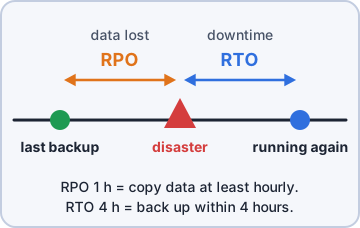
Exam tip RPO looks BACK (data lost since last copy). RTO looks FORWARD (time until running).
MTTR and MTBF
Mean time to repair (MTTR): average time to fix a failed component and return it to service. Lower is better. Mean time between failures (MTBF): average running time between failures of a repairable device. Higher is better.
Exam tip MTBF big, MTTR small = reliable gear and a fast team.
Objective 3.3
DR sites and high availability
Cold, warm, hot sites
Recovery sites trade cost for speed:
- Cold site: space, power, cooling, maybe connectivity. No ready gear or data. Cheapest, slowest (days to weeks).
- Warm site: hardware and connectivity in place, data needs restoring from backup. Hours to days.
- Hot site: fully equipped and running with near-real-time data. Switch over in minutes. Most expensive.
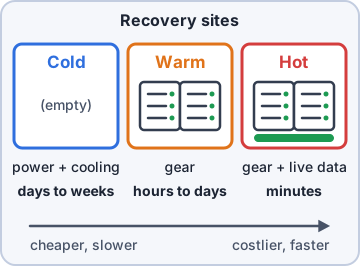
Exam tip Match the site to the RTO. An RTO of minutes needs a hot site; a cold site cannot meet it.
Active-active vs. active-passive
High availability (HA) pairs devices so one failure does not stop service. Active-active: both units carry traffic at once (load shared); if one fails, the other takes it all. Active-passive: one unit works while the standby waits, synced and ready, and takes over on failure.
Exam tip Active-active: watch capacity. If each unit runs at 70%, one alone cannot carry 140% after a failure.
Testing the plan
An untested plan is a wish. Tabletop exercise: the team walks through a scenario around a table, talking through who does what, with no systems touched. Validation test: actually perform steps, such as restoring backups or failing over to the DR site, to prove the plan works and meets RTO/RPO.
Exam tip Tabletop = talk it through. Validation = do it for real.
Check yourself 1Kibble's online store can lose at most 15 minutes of orders, and must be back within 2 hours. What is the 15-minute figure?
- Mean time to repair
- Recovery point objective
- Mean time between failures
- Recovery time objective
Show the answer
Answer: B. Recovery point objective
RPO is the maximum acceptable data loss measured in time. The 2-hour figure is the RTO.
Practice questions
Answer in your head, then open the answer. Ranger's Packet Trail has 483 questions like these for Network+, with mock exams.
Question 1Management says the order system can lose at most 15 minutes of transactions in a disaster. Which DR metric does this define?
- MTTR
- RTO
- MTBF
- RPO
Show the answer
Answer: D. RPO
Recovery point objective (RPO) is the maximum acceptable data loss measured in time, which drives how often you back up or replicate. RTO is how long recovery may take.
Question 2After a disaster, the call center must be back online within four hours. Which DR metric is this?
- RPO
- RTO
- SLA
- MTBF
Show the answer
Answer: B. RTO
Recovery time objective (RTO) is the maximum acceptable time to restore a service after a disruption. RPO is about how much data may be lost.
Question 3A firewall model's failure records for the last year are shown in the exhibit. What are the MTBF and MTTR for this model?
- MTBF 4,000 hours; MTTR 2 hours
- MTBF 2,000 hours; MTTR 5 hours
- MTBF 4,000 hours; MTTR 10 hours
- MTBF 20,000 hours; MTTR 2 hours
Show the answer
Answer: A. MTBF 4,000 hours; MTTR 2 hours
MTBF = operating time / failures = 20,000 / 5 = 4,000 hours. MTTR = total repair time / repairs = 10 / 5 = 2 hours.
Question 4Two switch models cost the same. The datasheet for Model A lists an MTBF of 250,000 hours; Model B lists 120,000 hours. What does Model A's higher figure indicate?
- Faster to repair
- Cheaper to replace
- More reliable
- Faster to recover data
Show the answer
Answer: C. More reliable
Mean time between failures measures reliability: the higher it is, the longer the device usually runs before failing. Repair speed is MTTR.
Question 5A company leases a second building that has power, cooling and network cabling, but no servers or network equipment installed. Which DR site is this?
- Active-active site
- Hot site
- Warm site
- Cold site
Show the answer
Answer: D. Cold site
A cold site provides space, power and basic infrastructure only; equipment and data must be brought in, so recovery takes the longest.
CompTIA, A+, Network+, Security+ and Linux+ are trademarks of CompTIA, Inc. Ranger Gamez is not affiliated with or endorsed by CompTIA. The practice questions are written to the published exam objectives; they are not real exam questions.