 RANGER
CompTIA Security+ (SY0-701) · chapter 7 of 27
Month 2: Who's out there, and how they get in
In this chapter Objectives 2.1, 2.2
Objective 2.1
Threat actors
Nation-state and organized crime
A nation-state actor works for a government: the most resources and the highest sophistication, patient long-term campaigns called advanced persistent threats (APTs), motives like espionage, data exfiltration, disruption and war. Organized crime groups are professional, well funded and driven by financial gain: ransomware, card theft, business email compromise, extortion. They often run like companies, with roles and help desks.
Exam tip Most resources and sophistication: nation-state. "Pay us or else" and profit: organized crime.
Hacktivist and unskilled attacker
A hacktivist attacks to push a philosophical or political cause: website defacement, DDoS, leaking documents. An unskilled attacker (once called a script kiddie) runs tools and scripts others wrote, without deep understanding; low sophistication and little funding, often motivated by curiosity, fame or causing chaos. Dangerous mainly because the tools are easy to get.
Exam tip Clue for hacktivist: a cause or message. Clue for unskilled attacker: downloaded tool, noisy, no clear target.
Insider threat and shadow IT
An insider threat is someone with authorized access (employee, contractor, partner) who misuses it, on purpose (revenge, money) or by carelessness. Insiders already know the systems and are inside the defenses. Shadow IT is staff using hardware, software or cloud services that IT hasn't approved, usually to get work done faster. Not malicious, but unmanaged, unpatched and invisible to security.
Exam tip Shadow IT is listed as a threat actor by CompTIA. A team buying its own cloud file-sharing account is shadow IT, not an insider attack.
Attributes of actors
CompTIA compares actors on three attributes. Internal/external: inside the organization (insider, shadow IT) or outside it. Resources/funding: money, people and time (nation-states and organized crime are rich; unskilled attackers are not). Level of sophistication/capability: from point-and-click tools to custom malware and zero-day exploits.
Actor          In?  Funding    Skill
-------------  ---  ---------  ---------
Nation-state   Ext  Very high  Very high
Org. crime     Ext  High       High
Hacktivist     Ext  Varies     Varies
Unskilled      Ext  Low        Low
Insider        Int  Low-med    Varies
Shadow IT      Int  Low        Low
Exam tip Exam questions often give you two attributes and ask for the actor.
Objective 2.1
Motivations
Why they attack
CompTIA lists these motivations. Data exfiltration: stealing data to sell or use. Espionage: spying for a government or competitor. Service disruption: taking services down. Blackmail: threatening to leak or harm unless paid. Financial gain: money. Philosophical/political beliefs: a cause. Ethical: hacking to improve security, such as authorized testers and bug-bounty researchers who disclose responsibly. Revenge: getting back at someone. Disruption/chaos: damage for its own sake. War: military goals between nations.
Exam tip Match motive to actor: revenge = insider; beliefs = hacktivist; money = organized crime; espionage and war = nation-state.
Check yourself 1A former Kibble & Co. warehouse supervisor, fired last month, uses a password he still knows to delete shipping records. Which actor and motivation fit BEST?
- Hacktivist, political beliefs
- Organized crime, financial gain
- Insider threat, revenge
- Shadow IT, convenience
Show the answer
Answer: C. Insider threat, revenge
He has knowledge and access from inside the company and acts to get back at it, which is an insider threat motivated by revenge. Nothing points to a cause or to profit.
Objective 2.2
Threat vectors: messages, files and devices
Vectors vs. attack surface
A threat vector is the path an attacker uses to get in (email, a USB stick, an open port). The attack surface is the total of all the places that could be attacked: every app, port, device, account and person. Security work shrinks the attack surface and watches the vectors that remain.
Exam tip Vector = the road in. Attack surface = all the doors and windows of the house.
Message-based, image-based, file-based
Message-based vectors: email (phishing links and attachments), SMS text messages and instant messaging (IM) in chat apps. Image-based: malicious content in images, such as an SVG holding HTML or JavaScript, data hidden with steganography, or a QR code leading to a phishing site. File-based: malicious documents and files such as PDFs with scripts, Office files with macros, compressed archives (ZIP, RAR) hiding executables.
Exam tip Clue: SVG files are XML and can carry script, which is why "it's just a picture" isn't safe.
Voice call and removable device
Voice call vectors include vishing calls, caller ID spoofing, voicemail scams and automated robocalls. Removable devices such as USB drives can carry malware, act as a keyboard that types commands, or be left in a parking lot hoping someone plugs one in (baiting). They can also cross an air gap into networks that aren't online, and carry data out.
Exam tip Mitigation clue: disable USB storage with policy, and train staff never to plug in found drives.
Objective 2.2
Attack surfaces in systems and networks
Vulnerable software: client-based vs. agentless
Vulnerable software is any software with flaws an attacker can exploit. Client-based software is installed on each device (an agent or app), so a flaw exists on every device it's on and each must be patched. Agentless software runs without an install, for example run on demand from a server or a web app; there is no footprint on devices, but a flaw on the central server affects every user at once.
Exam tip Client-based: patch every endpoint. Agentless: patch the one server, but it's a single point everyone depends on.
Unsupported systems and unsecure networks
Unsupported systems and applications no longer get security patches, so every new flaw stays open forever. Unsecure networks: wireless (open Wi-Fi, old WEP/WPA, rogue access points), wired (open network jacks with no 802.1X or port security, so anyone can plug in), and Bluetooth (devices left discoverable, flaws in Bluetooth stacks, data theft from paired devices).
Exam tip A wired jack in the lobby with no network access control is an attack surface even with perfect Wi-Fi.
Open service ports and default credentials
Every open service port is a listening service an attacker can probe, and each needs to be needed, patched and filtered; close the rest. Default credentials are the factory usernames and passwords (admin/admin) on routers, cameras, printers and IoT gear; attackers keep lists of them and scan for devices that still use them.
Exam tip Default credentials are one of the most common ways IoT devices are taken over in bulk. Change them on day one.
Supply chain
The supply chain vector attacks you through someone you trust. Managed service providers (MSPs) often hold remote admin access to many customers at once, so one breached MSP opens many doors. Vendors sell you software and hardware that may carry flaws or tampering. Suppliers provide components and services that could be counterfeit or compromised before they reach you.
Exam tip Mitigation clue: vendor risk assessments, least-privilege access for MSPs, and verifying hardware sources.
Objective 2.2
Human vectors and social engineering
Phishing, vishing, smishing
Phishing uses fraudulent messages, usually email, to trick people into clicking, opening or revealing information; spear phishing targets specific people. Vishing is voice phishing over the phone. Smishing is SMS phishing by text message. All rely on urgency, authority and fear.
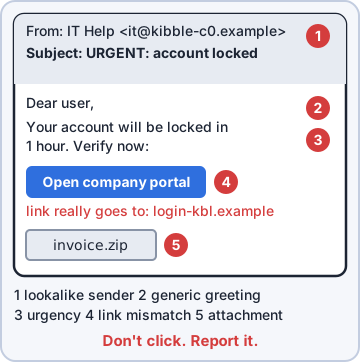
Exam tip V = voice, S = SMS. Phishing = the email (or general) version.
Impersonation, pretexting, BEC
Impersonation is pretending to be someone else, such as IT support, a vendor or an executive. Pretexting is the invented story that makes the request believable ("I'm from the auditors and need the payroll file by noon"). Business email compromise (BEC) uses a real compromised business email account or a convincing fake one, often an executive's or a vendor's, to get staff to wire money, change bank details or send sensitive data.
Exam tip Pretexting is the story; impersonation is the fake identity; BEC is the fraud done through business email.
Watering hole, brand impersonation, typosquatting
A watering hole attack compromises a website the targets already visit (like a pet-industry trade forum) and waits for them. Brand impersonation copies a known brand's logos and style in emails or sites to borrow its trust. Typosquatting registers misspelled lookalike domains (kibbelco.example, kibbleco-shop.example) to catch typos or fool readers.
Exam tip Watering hole: the attacker goes to where victims gather instead of contacting them.
Misinformation and disinformation
Misinformation is false information shared without intent to deceive. Disinformation is false information spread on purpose to mislead, often through fake accounts and social media, to sway opinion, damage a brand or support an attack. A fake post claiming "Kibble & Co. food recalled!" spread by a rival is disinformation.
Exam tip Dis = deliberate. Mis = mistaken.
Check yourself 2Staff at several pet-supply companies get malware after visiting a popular pet-industry trade forum that attackers had quietly compromised. What attack is this?
- Typosquatting
- Watering hole
- Brand impersonation
- Spear phishing
Show the answer
Answer: B. Watering hole
Attackers compromised a site the targets already visit and waited for them, which is a watering hole attack. Typosquatting would need a misspelled lookalike domain.
Practice questions
Answer in your head, then open the answer. Ranger's Cyber Patrol has 60 questions like these for Security+, with mock exams.
Question 1Kibble & Co.'s shipping system is hit by malware that displays a ransom note during the holiday peak. The incident team's findings are in the exhibit. Which motivation BEST explains the attack?
- Service disruption
- Financial gain
- Blackmail
- Data exfiltration
Show the answer
Answer: A. Service disruption
The data cannot be recovered even by paying, the contact channel was dead and nothing was stolen, so the ransom note is a cover for wrecking operations at the worst time. That points to service disruption rather than financial gain.
Question 2A CASB report shows that 14 marketing staff uploaded 2.3 GB, including a customer list, to an unapproved design app over the last 30 days. The team says it adopted the app to meet a deadline and did not know approval was needed. Which classification and response fit BEST?
- Unskilled attacker; reset the 14 users' passwords
- Shadow IT; assess the app and move the work to an approved tool
- Malicious insider; disable all 14 accounts and open an HR case at once
- Organized crime exfiltration; call law enforcement
Show the answer
Answer: B. Shadow IT; assess the app and move the work to an approved tool
Staff using an unapproved service without IT's knowledge, with no intent to harm, is shadow IT. The fix is to assess the app, protect the customer data already uploaded and give the team an approved option, not treat staff as attackers.
Question 3An alert fires on a contractor's account. The contractor was on a flight with no laptop, and his employer confirms his workstation was powered off all night. Based on the exhibit, which conclusion is BEST supported?
- Shadow IT set up by the contractor's own employer
- A hacktivist preparing a public political statement
- An external actor is using the contractor's stolen credentials
- A malicious insider: the contractor is copying files for himself
Show the answer
Answer: C. An external actor is using the contractor's stolen credentials
The contractor's alibi is verified and the login came from an address never seen before, so someone outside is using his valid credentials. Using an insider's account does not make the attacker an insider threat.
Question 4Kibble & Co.'s security inbox gets this message: "Your loyalty-points API leaks member addresses. I kept 5,000 records as proof. Send $8,000 in crypto within 7 days or I post the records and the flaw publicly. Pay, and I delete my copy and send you the details." Which motivation BEST describes the sender?
- Philosophical/political beliefs
- Revenge
- Ethical
- Blackmail
Show the answer
Answer: D. Blackmail
Threatening to publish stolen data and a flaw unless paid is coercion, which CompTIA calls blackmail. Ethical hackers report flaws without demands and do not hold customer data hostage.
Question 5The exhibit shows an external scan of Kibble & Co.'s web shop server. Its only job is serving customers over HTTPS, and admins reach it only through the company VPN. Which TWO findings should be removed from the internet-facing attack surface FIRST? (Choose two.)
- HTTPS with TLS 1.3 on 443/tcp
- SNMP v2c on 161/udp with the 'public' community
- SSH on 22/tcp, filtered to the VPN range
- RDP on 3389/tcp, reachable from any address
- HTTP on 80/tcp that redirects to HTTPS
Show the answer
Answers: B. SNMP v2c on 161/udp with the 'public' community, D. RDP on 3389/tcp, reachable from any address
RDP open to any address and SNMP v2c with a default community string give attackers an admin service and a default credential that the shop does not need online. The redirect and HTTPS serve customers, and SSH is already limited to the VPN.
CompTIA, A+, Network+, Security+ and Linux+ are trademarks of CompTIA, Inc. Ranger Gamez is not affiliated with or endorsed by CompTIA. The practice questions are written to the published exam objectives; they are not real exam questions.