 RANGER
AWS Certified Cloud Practitioner (CLF-C02) · chapter 12 of 14
Smart helpers
In this chapter Objectives 3.7, 3.8
- AI and machine learning services
- Building your own and asking an assistant
- Analytics services
- Application integration and business apps
- Tools for builders and users
- AWS AI and machine learning services
- AWS analytics services
- Customer enablement: getting help from AWS
- Developer tools: build, deploy, trace
- Internet of Things: AWS IoT Core
- End-user computing: desktops and apps streamed to users
- Practice questions
- Chapter recap
Objective 3.7
AI and machine learning services
AI, ML and three layers of help
Artificial intelligence (AI) is software doing tasks that normally need human thinking: understanding speech, reading text, recognizing images. Machine learning (ML) is the main way to get there: a model learns patterns from example data instead of following hand-written rules. AWS offers it in layers: ready-made AI services you call like any other service, a platform for building your own models, and analytics services that prepare the data.
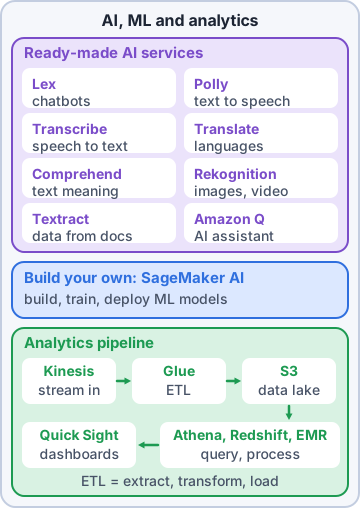
Exam tip No ML experts on staff? Pick a ready-made AI service. Your own custom model? Amazon SageMaker AI.
Ready-made AI services
Each one does one job, no ML skills needed.
- Amazon Lex: chatbots that understand voice and text conversations
- Amazon Polly: turns text into lifelike speech
- Amazon Transcribe: turns speech into text
- Amazon Translate: translates text between languages
- Amazon Comprehend: finds meaning in text, such as sentiment, key phrases and topics
- Amazon Rekognition: analyzes images and video (objects, faces, text, unsafe content)
- Amazon Textract: pulls text, forms and tables out of scanned documents
Ranger: barks at the speaker when Polly reads an order aloud
Check yourself 1Support records every customer call. Maya wants the recordings turned into text so they can be searched. Which service does that?
- Amazon Polly
- Amazon Transcribe
- Amazon Translate
- Amazon Lex
Show the answer
Answer: B. Amazon Transcribe
Transcribe converts speech to text. (Polly does the opposite: text to speech.)
Objective 3.7
Building your own and asking an assistant
Amazon SageMaker AI and Amazon Q
Amazon SageMaker AI is the service for building, training and deploying your own ML models, with managed notebooks, training jobs and hosting, for when no ready-made service fits, such as forecasting kibble demand per store. Amazon Q is AWS's generative AI assistant: it creates answers and content, helping staff get answers from company data and helping developers build and run on AWS. (Its company-data assistant, Amazon Q Business, is closed to new customers: AWS now points those projects to Amazon Quick.)
Exam tip Name check: the exam guide says Amazon SageMaker AI (renamed from Amazon SageMaker in late 2024). Custom models = SageMaker AI. Generative AI assistant = Amazon Q.
Check yourself 2Kibble & Co.'s new data scientist wants to train a custom model that predicts weekly demand for each store, using five years of sales data. Which service fits?
- Amazon Comprehend
- Amazon Rekognition
- Amazon Textract
- Amazon SageMaker AI
Show the answer
Answer: D. Amazon SageMaker AI
SageMaker AI is the platform to build, train and deploy your own ML models on your own data.
Objective 3.7
Analytics services
Collect, prepare, query
A typical analytics pipeline:
- Amazon Kinesis: collects and processes streaming data in real time, such as clicks on the shop
- AWS Glue: serverless extract, transform, load (ETL): finds, cleans and catalogs data so others can query it
- Amazon Athena: runs standard Structured Query Language (SQL) queries directly on files in Amazon Simple Storage Service (Amazon S3), with no servers; you pay per query
- Amazon EMR: runs big data frameworks such as Apache Spark and Hadoop on managed clusters
Dev: Kinesis is the firehose, Glue is the kitchen, S3 is the pantry, Athena is the taste test.
Ranger: perks up at "kitchen"
Store, search, show
Amazon Redshift (from the database picker) is the data warehouse for fast SQL analytics on large history. Amazon OpenSearch Service powers search boxes and log analytics, such as searching millions of order logs in seconds. Amazon Quick Sight is the business intelligence (BI) service: interactive dashboards and reports, shareable on any device.
Mr. Barkley: Quick Sight. Quick is my favorite speed.
Exam tip Real-time streams = Kinesis. ETL and data catalog = Glue. SQL on S3, serverless = Athena. Dashboards = Quick Sight. Spark/Hadoop = EMR.
Check yourself 3Order exports already sit in S3 as files. Dev wants to run occasional SQL queries on them without loading them into a database or managing servers. Which service fits best?
- Amazon Kinesis
- Amazon Athena
- Amazon EMR
- Amazon Quick Sight
Show the answer
Answer: B. Amazon Athena
Athena queries data in S3 with standard SQL, serverless, paying per query.
Objective 3.8
Application integration and business apps
Messages, queues and events
These pass messages so parts of an app don't depend on each other. (AWS Step Functions coordinates multi-step workflows.)
- Amazon Simple Notification Service (Amazon SNS): publish one message to a topic; it is pushed to every subscriber at once (fan-out), such as queues, functions, email or text messages (SMS)
- Amazon Simple Queue Service (Amazon SQS): a queue that holds messages until a worker pulls them, so nothing is lost if the worker is busy or down
- Amazon EventBridge: routes events from AWS services, your apps and software as a service (SaaS) apps to targets by rules, and runs schedules
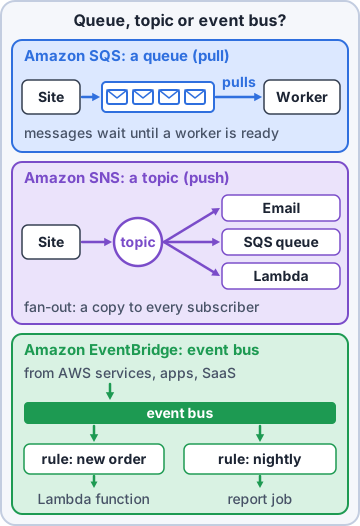
Exam tip Push to many at once = SNS. Hold work until someone is ready = SQS. Route events by rules or on a schedule = EventBridge.
Business applications: Amazon SES and Amazon Connect
Amazon Simple Email Service (Amazon SES) sends email at scale from your apps: order receipts, password resets and newsletters. Amazon Connect is a cloud contact center: phone and chat for customer service agents, set up in minutes and paid for as you use it. SNS can send email alerts too, but SES is the choice for real customer email.
Rosa: A call center that needs no phone closet? Ranger, we're losing all our closets.
Ranger: whimpers
Exam tip Alert the on-call team = SNS. Branded receipts to customers = SES. A call center = Amazon Connect.
Check yourself 4Orders must wait safely until the packing system is ready to process them, even if it's down for an hour. Which service fits best?
- Amazon SNS
- Amazon SES
- Amazon SQS
- Amazon Connect
Show the answer
Answer: C. Amazon SQS
SQS queues messages durably until a worker pulls them, decoupling the shop from the packing system.
Objective 3.8
Tools for builders and users
Developer tools: CodeBuild, CodePipeline, X-Ray
AWS CodeBuild compiles code, runs tests and produces ready-to-deploy packages, with no build servers to manage. AWS CodePipeline automates the release steps (source, build, test, deploy) every time code changes: continuous integration and continuous delivery (CI/CD). AWS X-Ray traces requests as they travel through an app's services, to find slow or failing steps.
Exam tip Build and test = CodeBuild. Automate the whole release = CodePipeline. Troubleshoot where a request slows down = X-Ray.
End-user computing, frontends and IoT
These services deliver apps and desktops, running on virtual machines (VMs) in AWS, to people's own screens.
- Amazon WorkSpaces: full virtual desktops (Windows or Linux) streamed to any device
- Amazon AppStream 2.0: streams single desktop apps to a web browser (AWS now calls it Amazon WorkSpaces Applications)
- Amazon WorkSpaces Secure Browser: safe browser access to internal websites, with no data left on the device
- AWS Amplify: builds, deploys and hosts frontend web and mobile apps
- AWS IoT Core: securely connects and manages Internet of Things (IoT) devices, like the warehouse's smart scales
Customer enablement: AWS Support
When the business needs help from AWS itself, that's AWS Support: from the free Basic Support every account gets to paid plans with 24/7 engineers and a named technical contact. Choosing the right option depends on how critical the workload is. The final chapter covers the plans in detail.
Check yourself 5Which services can show an app or desktop running in AWS on an employee's own laptop? Choose two.
- AWS IoT Core
- Amazon WorkSpaces
- AWS CodePipeline
- Amazon AppStream 2.0
- Amazon SES
Show the answer
Answers: B. Amazon WorkSpaces, D. Amazon AppStream 2.0
WorkSpaces streams whole virtual desktops; AppStream 2.0 streams individual applications. Both present VM output on end-user devices.
Go deeper
More on the objectives in this chapter, in the same exam-ready detail.
Objective 3.7 · AWS AI/ML services
AWS AI and machine learning services
Ready-made AI services
Use these through an API, no ML expertise needed:
- Amazon Rekognition: analyze images and video (faces, objects, text)
- Amazon Comprehend: find meaning and sentiment in text
- Amazon Transcribe: speech to text
- Amazon Polly: text to speech
- Amazon Translate: language translation
- Amazon Lex: chatbots (voice and text)
- Amazon Textract: extract text and data from documents
- Amazon Kendra: intelligent enterprise search
- Amazon Bedrock: build generative AI apps with foundation models
- Amazon Q: generative AI assistant for business and developers
Build your own
Amazon SageMaker AI is the platform to build, train and deploy your own machine learning models.
Exam tip Speech to text = Transcribe; text to speech = Polly (it 'talks like a parrot').
Objective 3.7 · AWS analytics services
AWS analytics services
The list to know
The analytics services named in the exam guide:
- Amazon Athena: query data in S3 with SQL, no servers, pay per query
- Amazon Redshift: data warehouse for large-scale analytics
- AWS Glue: serverless ETL (extract, transform, load) and a data catalog
- Amazon EMR: big data frameworks (Spark, Hadoop)
- Amazon Kinesis and Amazon Data Firehose: collect and process streaming data in real time
- Amazon QuickSight: business intelligence dashboards
- Amazon OpenSearch Service: search and log analytics
- Amazon MSK: managed Apache Kafka
Quick matching
Ad-hoc SQL on files in S3 = Athena. Dashboards for managers = QuickSight. Clickstream in real time = Kinesis. Prepare and move data = Glue.
Objective 3.8 · Customer enablement services (for example, AWS Support)
Customer enablement: getting help from AWS
Support plans
The CLF-C02 exam guide lists Basic (free: billing and account support, documentation, re:Post, core Trusted Advisor checks, AWS Health Dashboard), Developer, Business, Enterprise On-Ramp and Enterprise. Higher plans add faster response times, 24/7 access to engineers, the full set of Trusted Advisor checks, and at the top a Technical Account Manager (TAM) and concierge billing help.
- Real-world change: AWS is retiring Developer and Business Support on January 1, 2027 (replaced by Business Support+) and folding Enterprise On-Ramp into Enterprise Support during 2026, in commercial Regions
- For the exam, learn the plans as the exam guide lists them
Exam tip Need a designated Technical Account Manager: Enterprise.
Other help
AWS Professional Services and the AWS Partner Network (APN) (consulting and technology partners), AWS Marketplace (third-party software), AWS re:Post (community Q&A), AWS Knowledge Center, AWS Skill Builder and AWS Training and Certification.
Objective 3.8 · Developer tool services and capabilities (for example, AWS CodeBuild, AWS CodePipeline, and AWS X-Ray)
Developer tools: build, deploy, trace
CI/CD tools
Tools that automate getting code from a developer to production:
- AWS CodePipeline: automates the release pipeline (source, build, test, deploy)
- AWS CodeBuild: compiles code and runs tests
- AWS CodeDeploy: deploys to EC2, Lambda, ECS or on-premises servers
- AWS CodeArtifact: stores software packages
- AWS CloudShell: a browser-based terminal
- AWS AppConfig: manage app configuration
AWS X-Ray
AWS X-Ray traces requests as they travel through your application's services so you can find slow or failing parts (bottlenecks) in distributed and microservice apps.
Exam tip Automate build-test-deploy = CodePipeline. Find which microservice is slow = X-Ray.
Objective 3.8 · IoT services (for example, AWS IoT Core)
Internet of Things: AWS IoT Core
What it does
AWS IoT Core securely connects billions of devices (sensors, appliances, vehicles) to AWS and routes their messages (MQTT, HTTPS) to other services for processing and storage. AWS IoT Greengrass runs AWS functions on the devices themselves at the edge.
Exam tip 'Collect data from thousands of sensors' = AWS IoT Core.
Objective 3.8 · Identifying the services that can present the output of virtual machines (VMs) on end-user machines
End-user computing: desktops and apps streamed to users
The services
These services run the computer in AWS and stream only the screen to the user:
- Amazon WorkSpaces: virtual Windows or Linux desktops (Desktop as a Service) that users reach from any device
- Amazon AppStream 2.0 (renamed Amazon WorkSpaces Applications in 2025): streams individual desktop applications to a web browser
- Amazon WorkSpaces Secure Browser: a managed, isolated browser for internal websites and SaaS apps
Why use them
Data stays in AWS, not on the user's laptop; new staff get a desktop in minutes; works from personal devices.
Exam tip Full desktop = WorkSpaces. One app in a browser = AppStream 2.0.
Practice questions
Answer in your head, then open the answer. Ranger's Cloud Kennel has 563 questions like these for AWS Cloud Practitioner, with mock exams.
Question 1A company's data scientists want one managed service to build, train and deploy their own machine learning models. Which service fits?
- Amazon Polly
- Amazon Translate
- AWS Glue
- Amazon SageMaker AI
Show the answer
Answer: D. Amazon SageMaker AI
Amazon SageMaker AI is AWS's managed platform to build, train and deploy machine learning models, used when a team needs custom models on its own data.
Question 2A retailer wants a chatbot on its website that understands typed or spoken questions such as "Where is my order?" and replies in a conversation. Which service is built for this?
- Amazon Comprehend
- Amazon Lex
- Amazon Textract
- Amazon Rekognition
Show the answer
Answer: B. Amazon Lex
Amazon Lex builds conversational interfaces (chatbots and voice bots) that understand user intent from text or speech.
Question 3A learning app must read lesson text aloud in a natural-sounding voice. Which service converts text into lifelike speech?
- Amazon Transcribe
- Amazon Lex
- Amazon Polly
- Amazon Translate
Show the answer
Answer: C. Amazon Polly
Amazon Polly turns text into lifelike speech in many voices and languages.
Question 4A support center wants written text of thousands of recorded phone calls so it can search them. Which service converts speech to text?
- Amazon Polly
- Amazon Comprehend
- Amazon Transcribe
- Amazon Rekognition
Show the answer
Answer: C. Amazon Transcribe
Amazon Transcribe uses automatic speech recognition to turn audio into text, such as call recordings and subtitles.
Question 5An online shop wants its English product descriptions available in Spanish, German and Japanese automatically. Which service fits?
- Amazon Comprehend
- Amazon Polly
- Amazon Textract
- Amazon Translate
Show the answer
Answer: D. Amazon Translate
Amazon Translate is a neural machine translation service that translates text between languages.
AWS and Amazon Web Services are trademarks of Amazon.com, Inc. or its affiliates. Ranger Gamez is not affiliated with or endorsed by Amazon. The practice questions are written to the published exam objectives; they are not real exam questions.