 RANGER
AWS Certified Cloud Practitioner (CLF-C02) · chapter 14 of 14
Help is a call away
In this chapter Objectives 4.3
Objective 4.3
Free help on official AWS websites
Documentation, whitepapers and blogs
AWS publishes a lot of free material on its official websites. AWS documentation (docs.aws.amazon.com) has user guides and references for every service. AWS whitepapers (on aws.amazon.com) are in-depth guides written by AWS and partners, such as the Well-Architected Framework and the Cloud Adoption Framework overview. AWS blogs announce new features and walk through real examples, such as the AWS Security Blog.
Exam tip Look for official sources on aws.amazon.com and docs.aws.amazon.com. A whitepaper is AWS's long-form guidance; docs are service how-tos.
Prescriptive Guidance, Knowledge Center and re:Post
AWS Prescriptive Guidance offers AWS-tested strategies, guides and step-by-step patterns for migrations and modernizing. The AWS Knowledge Center answers the questions customers ask AWS Support most often. AWS re:Post is AWS's community question-and-answer site, where AWS experts and other customers answer questions; anyone can use it.
Sam: re:Post is where I go when the error message makes no sense. Somebody always had it first.
Exam tip Ask the community = re:Post. Common Support answers = Knowledge Center. Proven migration patterns = Prescriptive Guidance.
AWS Support Center
AWS Support Center is the place in the AWS Management Console where you open and track support cases with AWS. Every account, even on Basic Support, can open cases about billing and account questions. Technical cases, such as "our database won't fail over", need a paid Support plan.
Check yourself 1Sam wants a free place to ask other AWS users and AWS experts why his CloudFormation template fails. Where should he post?
- AWS re:Post
- AWS Trusted Advisor
- AWS Artifact
- AWS Health Dashboard
Show the answer
Answer: A. AWS re:Post
re:Post is AWS's community Q&A site, open to everyone, with answers from the community and AWS experts.
Objective 4.3
AWS Support plans
Four plans, one ladder
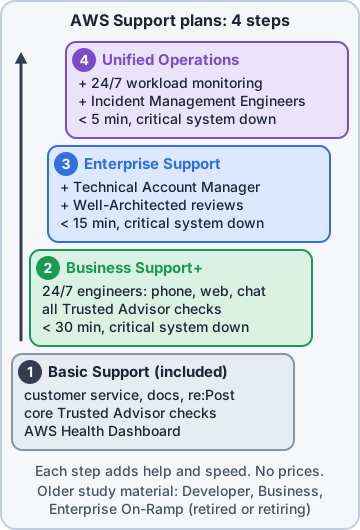
AWS's current AWS Support plans build on each other.
- Basic Support: included with every account. Customer service for account and billing, documentation, re:Post, core Trusted Advisor checks, the AWS Health Dashboard
- AWS Business Support+: AWS's recommended minimum for production. 24/7 phone, web and chat with engineers, all Trusted Advisor checks, fast response when a business-critical system is down
- AWS Enterprise Support: for business-critical workloads. Adds a designated Technical Account Manager (TAM), Well-Architected reviews and faster response
- AWS Unified Operations: for mission-critical workloads. Adds 24/7 workload monitoring and incident management engineers, with the fastest response
Exam tip Older study material may mention Developer, Business or Enterprise On-Ramp plans. Developer and Business closed to new customers in December 2025.
What a TAM does, and how fast help comes
A Technical Account Manager (TAM) is a named AWS technical contact who knows your workloads, guides you proactively, and pulls in the right experts. The lowest plan with a designated TAM is Enterprise Support. Response targets get faster as you climb: AWS lists under 30 minutes for a business-critical system down on Business Support+, under 15 minutes on Enterprise Support and under 5 minutes on Unified Operations.
Mr. Barkley: So a TAM is a personal trainer for our cloud. Do we need one?
Dev: Not yet. Business Support+ fits a shop our size.
Exam tip Exam pattern: "needs a designated TAM at the lowest cost" = Enterprise Support. "Production, 24/7 engineer access, lowest cost" = Business Support+. Never quote prices.
Check yourself 2A company runs production on AWS and wants 24/7 phone and chat access to engineers and the full set of Trusted Advisor checks, at the lowest cost. It doesn't need a TAM. Which plan fits?
- Basic Support
- AWS Business Support+
- AWS Enterprise Support
- AWS Unified Operations
Show the answer
Answer: B. AWS Business Support+
Business Support+ is AWS's recommended minimum for production: 24/7 engineer access by phone, web and chat, plus all Trusted Advisor checks.
Objective 4.3
Tools that watch your environment
Trusted Advisor, Health Dashboard and Health API
AWS Trusted Advisor checks your account against best practices in categories such as cost optimization, performance, security, fault tolerance and service limits; cost checks flag idle and underused resources. The AWS Health Dashboard shows the status of AWS services and, in your account health, the events that affect your own resources, such as scheduled maintenance. The AWS Health API (application programming interface) gives that same information to your tools; it needs a paid Support plan.
Maya: Trusted Advisor tells us what we did wrong. The Health Dashboard tells us what AWS is doing to our stuff.
Exam tip "Is AWS having a problem that affects MY resources?" = Health Dashboard. "How can I save money or close security gaps?" = Trusted Advisor.
Objective 4.3
Reporting abuse
The AWS Trust and Safety team
If AWS resources are being used for abuse, such as spam, port scanning, denial of service attacks, malware hosting or phishing, anyone can report it to the AWS Trust and Safety team through AWS's abuse report form. The same team contacts customers whose resources are reported, for example a compromised instance sending spam, and expects them to fix it.
Ranger: growls at an imaginary spammer
Exam tip Abuse FROM an AWS resource (spam, attacks, illegal content) = report to AWS Trust and Safety, not to AWS Support.
Check yourself 3Priya notices that an Internet Protocol (IP) address belonging to AWS is scanning Kibble & Co.'s office network every night. The address isn't one of Kibble & Co.'s. What should she do?
- Open a technical case in AWS Support Center
- Report it to the AWS Trust and Safety team
- Post the IP address on AWS re:Post
- Run AWS Trusted Advisor
Show the answer
Answer: B. Report it to the AWS Trust and Safety team
Suspected abuse coming from AWS resources is reported to AWS Trust and Safety, which investigates and contacts the resource owner.
Objective 4.3
People and partners
The AWS Partner Network
The AWS Partner Network (APN) is the community of companies that build on AWS. Independent software vendors (ISVs) make software that runs on or with AWS. System integrators (SIs) and consulting partners help customers plan, migrate, build and manage workloads. Partners get benefits such as training and certification, partner events, marketing support and volume discounts.
AWS Marketplace: buy, govern, track
AWS Marketplace is the catalog where ISVs sell software, data and services that run on AWS. Key services: cost management (charges appear on your AWS bill and in cost tools; flexible pricing such as free trials, hourly or annual), governance (a private marketplace limits staff to approved products) and entitlement (tracking which licenses you own and who can use them, with AWS License Manager).
Priya: A private marketplace means staff can only buy the security tools I've approved.
Experts from AWS
Sometimes you want AWS's own people. AWS Professional Services is AWS's global team of experts who work with customers, often alongside partners, on big projects such as large migrations. AWS solutions architects are AWS technical experts who help customers design solutions that follow best practices. AWS Support plans, the TAM and partners round out the help.
Exam tip Hands-on project help from AWS itself = Professional Services. Design advice from AWS = solutions architects. A partner company = APN.
Check yourself 4Which are roles of AWS Partners? Choose two.
- ISVs selling software through AWS Marketplace
- Running AWS's data centers and hardware
- System integrators helping customers migrate to AWS
- Issuing AWS compliance reports in AWS Artifact
- Answering abuse reports for AWS
Show the answer
Answers: A. ISVs selling software through AWS Marketplace, C. System integrators helping customers migrate to AWS
ISVs build and sell software that runs on AWS, often through AWS Marketplace; system integrators and consulting partners help customers design, migrate and manage.
Objective 4.3
Whole-exam review: getting ready for CLF-C02
The exam at a glance
The AWS Certified Cloud Practitioner (CLF-C02) exam has 65 questions in 90 minutes: 50 scored and 15 unscored ones you can't tell apart. Scores run from 100 to 1,000 and you pass at 700. Scoring is compensatory: you pass the exam as a whole, not each domain. Weights: Cloud Concepts 24%, Security and Compliance 30%, Cloud Technology and Services 34%, Billing, Pricing, and Support 12%.
You: So I don't need a perfect score, just 700 across the whole exam.
Dev: Right. A weak domain can be balanced by a strong one.
Exam tip Unanswered questions count as wrong, and there's no penalty for guessing. Never leave a question blank.
Pacing and question types
Two question types: multiple choice (one right answer of four) and multiple response (two or more right of five or more; the question says "Choose two" or "Choose three"). That's about 80 seconds per question.
- First pass in about 60 minutes: answer what you know, flag what you don't
- Second pass: return to flagged questions with the time left
- Multiple response: judge each option true or false on its own, then pick exactly the number asked; assume no partial credit
- Look for the deciding words: "least operational overhead", "most cost-effective", "lowest cost", "highly available"
Look-alikes to tell apart
Many questions come down to one classic pair. Quick review:
- CloudTrail who did what; CloudWatch how is it doing; Config what did it look like
- Shield floods, WAF (web application firewall) bad web requests, GuardDuty threats, Inspector vulnerabilities, Macie data in Amazon Simple Storage Service (Amazon S3)
- Security group: instance, stateful. Network ACL (access control list): subnet, stateless
- SNS (notifications) pushes to many; SQS (queues) holds work; EventBridge routes events
- Pricing Calculator before; Budgets alerts; Cost Explorer after; Cost and Usage Report for detail
- Region > Availability Zone > data center; edge locations near users
The week before, and on the day
Take at least two full-length practice exams under time, then study each wrong answer until you can explain why every option is right or wrong. Spend extra time on the domains with the most weight and your lowest scores. Reread the chapter recaps and memory tricks. For an online exam, test your computer and clear your desk early; bring the ID the testing provider requires; sleep well the night before.
Maya: Read every word of the question twice. The exam hides the answer in one adjective.
Ranger: yawns: sleep is part of the plan
Check yourself 5During the exam you meet a question that says "Choose two." Which tactics are sound? Choose two.
- Judge each option as true or false on its own
- Leave it blank if unsure, to avoid a penalty
- Select exactly two options
- Select three options to raise your chances
- Skip all multiple-response questions
Show the answer
Answers: A. Judge each option as true or false on its own, C. Select exactly two options
Evaluate each option independently and select exactly the number asked. Blank answers count as wrong, and there's no penalty for guessing.
Practice questions
Answer in your head, then open the answer. Ranger's Cloud Kennel has 563 questions like these for AWS Cloud Practitioner, with mock exams.
Question 1Dev asks you to find AWS's official long-form documents on cloud best practices, such as the AWS Well-Architected Framework. Where are they published?
- AWS re:Post
- AWS Marketplace
- AWS Artifact
- AWS Whitepapers & Guides on the AWS website
Show the answer
Answer: D. AWS Whitepapers & Guides on the AWS website
AWS publishes whitepapers and technical guides (Well-Architected, security, cost, migration) on the AWS Whitepapers & Guides pages of aws.amazon.com, free for everyone.
Question 2The team wants AWS-tested strategies, step-by-step guides and patterns for migrating and modernizing workloads. Which AWS resource is built for this?
- AWS Knowledge Center
- AWS Prescriptive Guidance
- AWS Health Dashboard
- AWS Trusted Advisor
Show the answer
Answer: B. AWS Prescriptive Guidance
AWS Prescriptive Guidance offers strategies, guides and patterns, written by AWS experts and partners, for migrating, modernizing and operating on AWS.
Question 3Sam keeps hitting a common question: how to recover access to an EC2 instance after losing the key pair. He wants an AWS-written article that answers frequent questions like this. Where should he look first?
- AWS Prescriptive Guidance
- AWS Knowledge Center
- AWS Marketplace
- AWS Trusted Advisor
Show the answer
Answer: B. AWS Knowledge Center
The AWS Knowledge Center (part of AWS re:Post) holds articles and videos written by AWS that answer the questions customers ask AWS Support most often.
Question 4Kibble & Co. is on Basic Support. Sam wants to post a question and get answers from the AWS community and AWS experts. Which resource fits?
- A technical case in the AWS Support Center
- AWS Professional Services
- AWS Prescriptive Guidance
- AWS re:Post
Show the answer
Answer: D. AWS re:Post
AWS re:Post is AWS's community question-and-answer site, open to everyone, where community members and AWS experts answer questions. It replaced the old AWS Forums.
Question 5A customer on the Basic Support plan has a technical how-to question about Amazon S3. Which free resources can help? Choose two.
- An Incident Management Engineer
- AWS documentation and the AWS Knowledge Center
- A technical support case answered by a support engineer
- AWS re:Post
- A designated Technical Account Manager
Show the answer
Answers: B. AWS documentation and the AWS Knowledge Center, D. AWS re:Post
Basic Support includes documentation, whitepapers, re:Post, the Knowledge Center, account and billing customer service, core Trusted Advisor checks and AWS Health. Technical engineers need a paid plan.
AWS and Amazon Web Services are trademarks of Amazon.com, Inc. or its affiliates. Ranger Gamez is not affiliated with or endorsed by Amazon. The practice questions are written to the published exam objectives; they are not real exam questions.