 RANGER
Microsoft Azure Fundamentals (AZ-900) · chapter 5 of 14
Mapping the sky
In this chapter Objectives 2.1
Objective 2.1
Datacenters, regions and availability zones
Datacenters
Azure's physical infrastructure starts with datacenters: facilities with servers in racks and dedicated power, cooling and networking, like an on-premises datacenter at a much larger scale. Azure has datacenters around the world, but you never pick or touch an individual datacenter. They're grouped into Azure regions and availability zones, and that's what you choose.
Regions
A region is a geographical area that contains at least one, but potentially several, datacenters that are nearby and networked together with a low-latency network. When you deploy most resources, you choose a region. Some services or virtual machine (VM) features are only available in certain regions. A few services are global and need no region, such as Microsoft Entra ID, Azure Traffic Manager and Azure DNS (Domain Name System).
Exam tip Pick a region close to your users for speed, and check that the service or VM size you need is offered there.
Availability zones
Availability zones are physically separate datacenters within one Azure region. Each zone is one or more datacenters with independent power, cooling and networking, and acts as an isolation boundary: if one zone goes down, the others keep working. Zones are linked by high-speed, private fiber-optic networks. Zone-enabled regions have a minimum of three zones, but not every region supports zones yet.
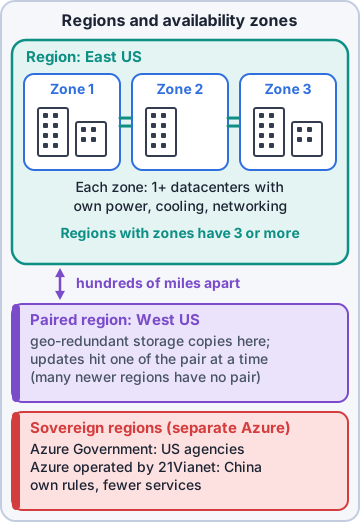
Using availability zones
Run copies of your resources in different zones of the same region for resilience. Duplicating services and moving data between zones can cost extra. Azure services that support zones come in three kinds:
- Zonal services: you pin the resource to a specific zone (VMs, managed disks, IP addresses)
- Zone-redundant services: the platform replicates across zones for you (zone-redundant storage, SQL Database)
- Non-regional services: always available from Azure geographies, resilient to zone-wide and region-wide outages
Gus: So my one VM in East US, no zone picked...
Dev: ...is one VM in one datacenter. One power problem and the shop's offline.
Check yourself 1Dev wants the Pawsome website to survive the loss of an entire datacenter, while staying in the East US region. What should he use?
- A second region on another continent
- Availability zones in East US
- A larger VM size
- A sovereign region
Show the answer
Answer: B. Availability zones in East US
Availability zones are separate datacenters inside one region, each with independent power, cooling and networking. Spreading instances across zones survives a datacenter failure.
Objective 2.1
Region pairs and sovereign regions
Region pairs
Most Azure regions are paired with another region in the same geography (such as US, Europe or Asia) at least 300 miles away. That lets you replicate resources across the geography, so a disaster, power outage or network outage in one region is less likely to stop you. Examples: West US is paired with East US, and Southeast Asia with East Asia. Not every service replicates or fails over automatically; for those, you set it up yourself.
What a pair gives you
A region pair is more than a backup location:
- In an extensive outage, one region of every pair is prioritized for recovery
- Planned Azure updates roll out to paired regions one region at a time
- Data stays in the same geography as its pair for residency and compliance (except Brazil South)
Exam tip Most pairs back each other up. Brazil South is the exception: paired one way with South Central US, outside its geography. Some regions have no pair and rely on zones instead.
Sovereign regions
Sovereign regions are instances of Azure isolated from the main instance, used for compliance or legal reasons. US DoD Central, US Gov Virginia, US Gov Arizona and others are physically and logically network-isolated for U.S. government agencies and partners, run by screened U.S. personnel. China East, China North and others are run through a partnership between Microsoft and 21Vianet; Microsoft doesn't directly maintain those datacenters.
Mr. Barkley: So Pawsome Pets won't need the Department of Defense region.
Dev: Not unless the dog treats become classified.
Check yourself 2Which statement about Azure region pairs is true?
- Paired regions are always on different continents
- Planned updates roll out to both regions of a pair at once
- Most pairs are in one geography, at least 300 miles apart
- Every Azure service copies its data to the paired region automatically
Show the answer
Answer: C. Most pairs are in one geography, at least 300 miles apart
Most regions are paired with another region in the same geography, at least 300 miles away, so one disaster is unlikely to hit both.
Practice questions
Answer in your head, then open the answer. Ranger's Sky Desk has 482 questions like these for Azure Fundamentals, with mock exams.
Question 1Maya wants the Pawsome Pets web servers to run in datacenters near the shop's customers in the Midwest. When she creates each resource in Azure, which choice decides where in the world it is deployed?
- The resource group
- The Azure region
- The availability set
- The subscription
Show the answer
Answer: B. The Azure region
An Azure region is a geographic area with one or more datacenters joined by a low-latency network, and you pick a region for each resource. Resource groups and subscriptions organize and bill resources but don't decide where they run.
Question 2Rosa asks whether data that Pawsome Pets replicates to its paired region could end up under another country's laws. Which statement about region pairs is accurate?
- Customers pick which region becomes the pair for their subscription
- Most pairs sit in the same geography, so replicated data stays in it
- Pairs are always on different continents to survive disasters
- Every resource is copied to the paired region automatically and at no cost
Show the answer
Answer: B. Most pairs sit in the same geography, so replicated data stays in it
Almost all region pairs are in the same geography, which serves as a data residency boundary, so geo-replicated data stays there. Brazil South, paired with South Central US, is a documented exception.
Question 3Mr. Barkley worries that a big outage could hit both regions Pawsome Pets uses. Dev explains what Microsoft does for region pairs. Which statements are true? Choose two.
- Every Azure region has exactly one paired region
- Planned updates are applied to one region in a pair at a time
- Customers can pair any two regions they want
- All virtual machines fail over to the paired region automatically
- In a broad outage, Microsoft prioritizes recovering one region of each pair
Show the answer
Answers: B. Planned updates are applied to one region in a pair at a time, E. In a broad outage, Microsoft prioritizes recovering one region of each pair
Region pairs give a recovery order (one region of each pair is prioritized) and staggered planned updates. Microsoft decides the pairs, some regions have none, and VMs are not failed over automatically.
Question 4Dev plans to use a newer Azure region that Microsoft lists with no paired region. According to Microsoft, what do nonpaired regions typically rely on as their main way to stay resilient?
- Moving workloads to Azure Government during outages
- Availability zones inside the region
- Geo-redundant storage copied to the region's pair
- An availability set that spans two regions
Show the answer
Answer: B. Availability zones inside the region
Many newer regions aren't paired and use availability zones as their primary means of redundancy. You can still build multiregion designs yourself, but geo-redundant storage needs a paired region.
Question 5A US federal agency that partners with Kibble & Co. needs its Azure workloads in a physically isolated cloud operated by screened US persons. Which Azure offering is built for this?
- ExpressRoute Direct
- Azure operated by 21Vianet
- A dedicated management group
- Azure Government
Show the answer
Answer: D. Azure Government
Azure Government is a sovereign cloud for US government agencies and their partners: physically and logically network-isolated and operated by screened US personnel. 21Vianet runs Azure in China.
Microsoft, Azure, Intune and Windows are trademarks of the Microsoft group of companies. Ranger Gamez is not affiliated with or endorsed by Microsoft. The practice questions are written to the published exam objectives; they are not real exam questions.