 RANGER
CompTIA Network+ (N10-009) · chapter 23 of 29
Week 23: The method
In this chapter Objectives 5.1
Objective 5.1
CompTIA's troubleshooting methodology
The seven steps
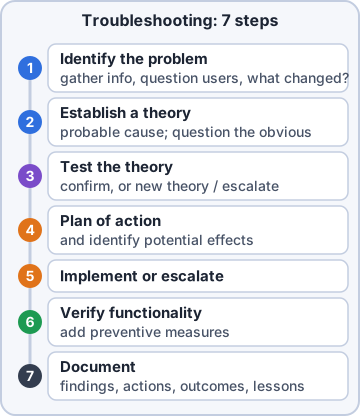
Memorize the order and the wording:
- 1. Identify the problem
- 2. Establish a theory of probable cause
- 3. Test the theory to determine the cause
- 4. Establish a plan of action to resolve the problem and identify potential effects
- 5. Implement the solution or escalate as necessary
- 6. Verify full system functionality and implement preventive measures if applicable
- 7. Document findings, actions, outcomes, and lessons learned throughout the process
Exam tip Documenting happens throughout and is the final step. Exam questions often ask 'what should the tech do NEXT?'
Step 1: Identify the problem
Collect facts before forming opinions:
- Gather information
- Question users
- Identify symptoms
- Determine if anything has changed
- Duplicate the problem, if possible
- Approach multiple problems individually
Exam tip 'What changed?' solves a huge share of tickets. Check change logs early.
Step 2: Establish a theory
Question the obvious (is it plugged in? is the port up?). Then consider multiple approaches: work through the OSI model top-to-bottom or bottom-to-top, or divide and conquer (start in the middle, like pinging the gateway, and move up or down based on the result).
Exam tip Bottom-to-top starts at Layer 1: cable, link light. Divide and conquer often starts at Layer 3 with ping.
Step 3: Test the theory
Test without changing too much. If the theory is confirmed, determine the next steps to resolve the problem. If it is not confirmed, establish a new theory or escalate.
Exam tip Testing a theory is not the same as fixing it. Swapping a cable to see if errors stop is a test.
Steps 4-7 in practice
Plan the fix and its potential effects (will rebooting the core drop the stores?), get approval through change management if needed, then implement or escalate. Verify full system functionality, not just the one symptom, and add preventive measures. Document findings, actions, outcomes and lessons learned.
Exam tip Fixed the problem? The next step is verify full functionality, not 'close the ticket'.
Check yourself 1A tech has confirmed a bad patch cable caused the drops and replaced it. What should the tech do NEXT?
- Question the users again
- Document findings and close the ticket
- Verify full system functionality
- Establish a new theory of probable cause
Show the answer
Answer: C. Verify full system functionality
After implementing the solution, verify full system functionality and add preventive measures, then document.
Practice questions
Answer in your head, then open the answer. Ranger's Packet Trail has 483 questions like these for Network+, with mock exams.
Question 1A help desk ticket says, "The Wi-Fi on the third floor is broken." Following CompTIA's troubleshooting methodology, what should the technician do FIRST?
- Establish a theory of probable cause
- Establish a plan of action
- Identify the problem
- Test the theory to determine the cause
Show the answer
Answer: C. Identify the problem
Step 1 is to identify the problem: gather information, question users and identify symptoms. Jumping to a theory first risks chasing the wrong cause.
Question 2A technician suspects a bad patch cable is causing a user's dropped connection. She swaps in a known-good cable, but the drops continue. According to the troubleshooting methodology, what should she do NEXT?
- Document findings and lessons learned
- Implement the solution
- Verify full system functionality
- Establish a new theory or escalate
Show the answer
Answer: D. Establish a new theory or escalate
When testing does not confirm the theory, CompTIA's next action is to establish a new theory or escalate. Implementing a solution only makes sense once a theory is confirmed.
Question 3A technician replaced a failed access switch and the users on it can log in again. Which step of the troubleshooting methodology should the technician perform NEXT?
- Verify full system functionality
- Document findings, actions and outcomes
- Establish a plan of action
- Question users to identify symptoms
Show the answer
Answer: A. Verify full system functionality
After implementing the solution, the technician verifies full system functionality (for example phones, printers, uplinks) and adds preventive measures if applicable. Documentation is the final step.
Question 4A technician fixed and verified an intermittent VPN outage. The team lead asks that the cause and fix be written into the knowledge base so others can resolve it faster next time. Which methodology step is this?
- Implement the solution or escalate as necessary
- Document findings, actions, outcomes, and lessons learned
- Establish a plan of action and identify potential effects
- Verify functionality and implement preventive measures
Show the answer
Answer: B. Document findings, actions, outcomes, and lessons learned
The last step is to document findings, actions, outcomes and lessons learned throughout the process. Verification and preventive measures come just before it.
Question 5A technician confirmed that a core switch's failing supervisor module is causing outages. Before swapping it, he checks which VoIP and payment systems will drop during the replacement and schedules a window. Which step is he performing?
- Test the theory to determine the cause
- Verify full system functionality and implement preventive measures
- Establish a plan of action and identify potential effects
- Implement the solution or escalate as necessary
Show the answer
Answer: C. Establish a plan of action and identify potential effects
Identifying what the fix will affect and planning around it is step 4, establish a plan of action to resolve the problem and identify potential effects.
CompTIA, A+, Network+, Security+ and Linux+ are trademarks of CompTIA, Inc. Ranger Gamez is not affiliated with or endorsed by CompTIA. The practice questions are written to the published exam objectives; they are not real exam questions.