 RANGER
CompTIA Network+ (N10-009) · chapter 5 of 29
Week 2: Copper, glass and air
In this chapter Objectives 1.5
Objective 1.5
Wireless media
802.11 Wi-Fi standards
Wi-Fi is defined by the IEEE 802.11 family. Know the band and the headline feature of each. Newer standards stay backward compatible within their band.
Std       Name      Band     Max*  Note
802.11a   -         5        54M   OFDM
802.11b   -         2.4      11M   DSSS
802.11g   -         2.4      54M   OFDM
802.11n   Wi-Fi 4   2.4/5    600M  MIMO
802.11ac  Wi-Fi 5   5        6.9G  MU-MIMO
802.11ax  Wi-Fi 6   2.4/5    9.6G  OFDMA
802.11ax  Wi-Fi 6E  + 6      9.6G  new band
802.11be  Wi-Fi 7   2.4/5/6  46G   MLO
Band in GHz. * theoretical, all streams
Exam tip Only 802.11a/n/ac/ax use 5 GHz; 802.11ac is 5 GHz ONLY. 6 GHz needs Wi-Fi 6E or newer.
Cellular
Cellular networks (4G LTE, 5G) give wide-area wireless data from carrier towers. Businesses use cellular routers for backup internet at stores, for kiosks, pop-up sites and IoT where no cable exists. 5G adds much higher speed and lower latency than LTE, especially on mid-band and mmWave frequencies (mmWave is short range and blocked easily by walls).
Exam tip Store loses its cable ISP but card readers keep working? A cellular failover link (LTE/5G) is the classic answer.
Satellite
Satellite internet reaches places with no cable or cell service. Geostationary (GEO) satellites sit about 35,786 km up, so a round trip takes roughly 600 ms or more: bad for VoIP and gaming. Low Earth orbit (LEO) constellations orbit a few hundred km up and give much lower latency (tens of ms). Rain and snow can cause signal fade, and you need a clear view of the sky.
Exam tip Satellite trade-off on the exam: available almost anywhere, but higher latency (especially GEO) and weather sensitivity.
Objective 1.5
Wired media and cable speeds
802.3 Ethernet over copper
Wired Ethernet is IEEE 802.3. Names like 1000BASE-T mean speed (1000 Mbps), BASE = baseband, T = twisted pair. Twisted pair is limited to 100 m per run (90 m horizontal + patch cords) for most categories.
Cable   Standard      Speed    Max
Cat 5e  1000BASE-T    1 Gbps   100 m
Cat 6   1000BASE-T    1 Gbps   100 m
Cat 6   10GBASE-T     10 Gbps  55 m
Cat 6a  10GBASE-T     10 Gbps  100 m
Cat 8   25/40GBASE-T  40 Gbps  30 m (DC)
Exam tip Cable speeds trap: Cat 6 runs 10 Gbps only to about 55 m. For 10 Gbps at a full 100 m, choose Cat 6a.
Single-mode vs multimode fiber
Fiber sends light, so it ignores EMI and runs much farther than copper. Single-mode fiber (SMF) has a tiny ~9 micron core, uses lasers, and runs kilometers (10 km, 40 km and more): campus and WAN links. Multimode fiber (MMF) has a wider 50 or 62.5 micron core, cheaper optics (LED/VCSEL), and runs hundreds of meters: inside buildings and data centers. Light bouncing in many paths (modal dispersion) limits MMF distance.
1000BASE-SX  MMF  ~550 m
1000BASE-LX  SMF  5 km (10 km on many)
10GBASE-SR   MMF  ~400 m (OM4)
10GBASE-LR   SMF  10 km
10GBASE-ER   SMF  40 km
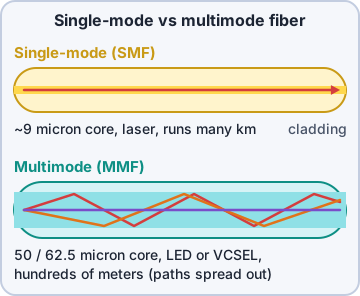
Exam tip S in SR/SX = short (multimode). L = long, E = extended (single-mode). Jacket color hint: yellow = SMF, aqua/orange = MMF.
DAC and twinaxial cable
A direct attach copper (DAC) cable is a short twinaxial copper cable with transceiver ends (SFP+, SFP28, QSFP) molded on. Twinax uses two inner conductors in one shield. DAC is cheap, uses little power and has very low latency, but only reaches a few meters (about 7 m passive). Perfect for a server to its top-of-rack switch. Need longer? Use an active optical cable or real optics plus fiber.
Exam tip Same rack, 3 m, 10/25 Gbps, cheapest option: DAC (twinax).
Coaxial cable
Coaxial cable has one center conductor, insulation, a braided shield and a jacket. RG-6 carries cable TV and cable-modem internet (DOCSIS) with F-type screw-on connectors. RG-59 is thinner, for short video runs. Older Ethernet and some video gear used BNC bayonet connectors on coax.
Exam tip The ISP cable modem in Store 2 connects with RG-6 and an F-type connector. Ethernet comes out the back on RJ45.
Plenum vs non-plenum cable
A plenum is a space used to move air for heating and cooling, such as above a drop ceiling used as a return air path or under a raised floor. In a fire, normal PVC jackets give off toxic smoke that the air system would spread. Plenum-rated cable (CMP) has a fire-retardant, low-smoke jacket and is required by fire code there. Non-plenum (PVC, CM/CMR riser) is cheaper and fine in walls, conduit and non-air spaces.
Exam tip Running cable through the ceiling air-return space? Plenum-rated. It costs more, but code requires it.
Objective 1.5
Transceivers and connectors
Transceivers: protocol and form factor
A transceiver (optic) plugs into a switch port and converts electrical signals to light or copper signals. It must match the protocol: Ethernet optics for LAN switches, Fibre Channel (FC) optics for SAN switches and storage arrays. It must match the fiber type and wavelength on both ends, and the switch must support it. Form factors: SFP (1 Gbps), SFP+ (10), SFP28 (25), QSFP (quad: QSFP+ 40, QSFP28 100 Gbps).
Exam tip Both ends of a link need compatible optics: same speed, same wavelength, same fiber type. An SR on one end and LR on the other will not link.
Fiber connectors
Know them by shape.
- SC (subscriber connector): square, push-pull, snaps in. "Square Connector / stick and click."
- LC (local connector): small form factor, latch like RJ45, usually duplex pairs. Standard on SFP optics.
- ST (straight tip): round bayonet, push and twist. Older multimode installs. "Stick and twist."
- MPO (multi-fiber push on): one rectangular ferrule with 12 or 24 fibers; used for 40/100G and trunk cables.
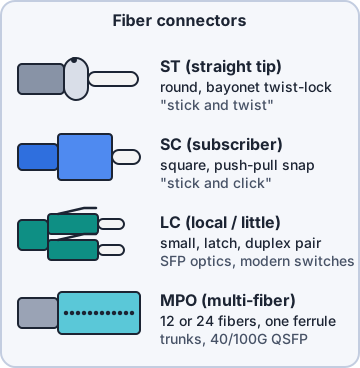
Exam tip Most SFP and SFP+ optics take a duplex LC patch cord. MPO shows up on QSFP 40/100G parallel optics.
Copper connectors
Four copper connectors on the exam.
- RJ45: 8 pins (8P8C), twisted-pair Ethernet.
- RJ11: smaller, 6 positions with 2 or 4 wired; analog phone lines, DSL, alarm/fax lines.
- F-type: threaded screw-on coax connector for cable modems and TV (RG-6).
- BNC: bayonet twist-lock coax connector; older Ethernet, CCTV and test gear.
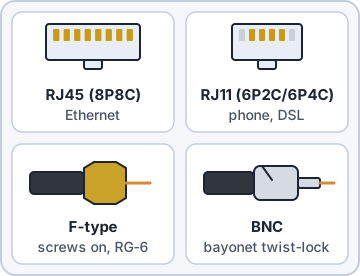
Exam tip Trap: an RJ11 fits loosely into an RJ45 jack, but never the other way. Phone = RJ11 (narrow), network = RJ45 (wide).
Check yourself 1Dev needs a 10 Gbps run of exactly 90 m from the IDF to a camera server room. Which copper cable meets the requirement with the least risk?
- Cat 5e
- Cat 6
- Cat 6a
- RG-6 coaxial
Show the answer
Answer: C. Cat 6a
Cat 6a supports 10GBASE-T to 100 m. Cat 6 supports 10 Gbps only to about 55 m, and Cat 5e is rated for 1 Gbps.
Check yourself 2Which connector is a small form factor fiber connector with a latch, commonly used in duplex pairs on SFP+ optics?
- LC
- ST
- F-type
- BNC
Show the answer
Answer: A. LC
LC (local connector) is the small, latching fiber connector used on most SFP/SFP+ transceivers. ST is a round bayonet fiber connector.
Practice questions
Answer in your head, then open the answer. Ranger's Packet Trail has 483 questions like these for Network+, with mock exams.
Question 1An office is buying new access points that support OFDMA and can operate in both the 2.4 GHz and 5 GHz bands. Which standard, also called Wi-Fi 6, do these APs support?
- 802.11g
- 802.11ax
- 802.11n
- 802.11ac
Show the answer
Answer: B. 802.11ax
802.11ax (Wi-Fi 6) added OFDMA and works in 2.4 GHz and 5 GHz, with Wi-Fi 6E adding 6 GHz. 802.11ac (Wi-Fi 5) works only in 5 GHz.
Question 2A warehouse sets its new APs to 802.11ac-only mode. Older handheld scanners that support only 802.11b/g/n on 2.4 GHz can no longer see the wireless network. What is the MOST likely reason?
- 802.11ac disables SSID broadcasts by default
- 802.11ac operates only in the 5 GHz band
- 802.11ac requires WPA3 on every client
- 802.11ac uses a shorter range than 802.11b
Show the answer
Answer: B. 802.11ac operates only in the 5 GHz band
802.11ac works only in 5 GHz, so 2.4 GHz-only clients can't see an ac-only network. The scanners would need a 2.4 GHz radio running 802.11n or a mixed mode.
Question 3A remote mining site connects to headquarters through a geostationary satellite link. Bandwidth is enough, but VoIP calls have long delays and people talk over each other. What is the MOST likely cause?
- Too few non-overlapping channels
- EMI from nearby heavy motors
- High propagation latency
- Crosstalk between cable pairs
Show the answer
Answer: C. High propagation latency
Geostationary satellites orbit about 35,786 km up, so each round trip adds roughly 600 ms or more of latency, which disrupts real-time calls. Crosstalk is a copper cabling problem.
Question 4Two buildings on a corporate campus are 10 km apart, and they need a 10 Gbps fiber link between them. Which type of fiber should be installed?
- Multimode fiber
- Single-mode fiber
- Cat 6a twisted pair
- RG-6 coaxial cable
Show the answer
Answer: B. Single-mode fiber
Single-mode fiber uses a narrow core and laser light to carry signals over many kilometers. Multimode fiber is limited to a few hundred meters at 10 Gbps.
Question 5A server 3 m from its top-of-rack switch needs a 25 Gbps connection. Both devices have SFP28 ports, and the team wants the cheapest, lowest-power option with no separate optics. What should be used?
- DAC twinaxial cable
- Cat 6 patch cable
- Single-mode fiber with LR optics
- RG-59 coaxial cable
Show the answer
Answer: A. DAC twinaxial cable
A direct attach copper (DAC) cable is twinax with SFP ends built in, which is cheap and low-power for runs of a few meters. Long-reach single-mode optics would cost far more and are meant for kilometers.
CompTIA, A+, Network+, Security+ and Linux+ are trademarks of CompTIA, Inc. Ranger Gamez is not affiliated with or endorsed by CompTIA. The practice questions are written to the published exam objectives; they are not real exam questions.