 RANGER
CompTIA Network+ (N10-009) · chapter 8 of 29
Week 5: The network of tomorrow (and IPv6)
In this chapter Objectives 1.8
Objective 1.8
IPv6 addressing
Why IPv6: mitigating address exhaustion
IPv4 has about 4.3 billion addresses and the free pools ran out years ago. NAT and private addressing stretched IPv4, but they add complexity and break some apps. IPv6 is the real fix for address exhaustion: 128-bit addresses (2^128, about 3.4 x 10^38), enough for every device to have a globally unique address. A standard IPv6 subnet is a /64, which alone holds 2^64 addresses.
Exam tip IPv6 also removes broadcast (uses multicast), uses Neighbor Discovery in place of ARP, and supports SLAAC so hosts can configure themselves.
Reading and shortening IPv6
An IPv6 address is 8 groups (hextets) of 4 hex digits separated by colons. Two rules to shorten it: (1) drop leading zeros in any group; (2) replace one run of consecutive all-zero groups with ::. You may use :: only once, or the address becomes ambiguous.
Full:
2001:0db8:0000:0000:0000:ff00:0042:8329
Rule 1 (drop leading zeros):
2001:db8:0:0:0:ff00:42:8329
Rule 2 (one zero run -> ::):
2001:db8::ff00:42:8329

Invalid: 2001::25::1  (:: used twice)
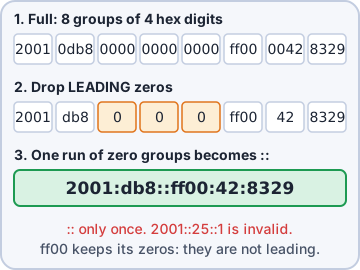
Exam tip Trap: you can drop LEADING zeros only. 0db8 becomes db8, but ff00 stays ff00.
IPv6 address types
Every IPv6 interface has several addresses at once.
Type            Prefix     Like IPv4
Global unicast  2000::/3   public
Unique local    fc00::/7   RFC1918
                (in use: fd00::/8)
Link-local      fe80::/10  APIPA-like,
                           never routed
Multicast       ff00::/8   (no broadcast)
Loopback        ::1        127.0.0.1
Unspecified     ::         0.0.0.0
Exam tip A host can build its own address with SLAAC from the router's /64 prefix plus an interface ID (random or EUI-64 from the MAC). DHCPv6 is the other option.
Compatibility: dual stack, tunneling, NAT64
IPv4 and IPv6 cannot talk to each other directly, so there are three compatibility requirements strategies.
- Dual stack: every device runs IPv4 and IPv6 side by side and uses whichever the destination supports. Most common, simplest to run.
- Tunneling: carry IPv6 packets inside IPv4 packets across an IPv4-only network (6to4, Teredo, GRE tunnels).
- NAT64: a translator lets IPv6-only clients reach IPv4-only servers, usually with DNS64 creating synthetic IPv6 answers.
Exam tip Network must cross an IPv4-only ISP = tunneling. IPv6-only clients reaching an old IPv4 server = NAT64. Run both everywhere = dual stack.
Objective 1.8
SDN and SD-WAN
Software-defined networking (SDN)
Network devices have planes: the data (forwarding) plane moves packets, the control plane decides where they go (routing tables, STP), and the management plane is how admins configure them (SSH, SNMP, APIs). SDN separates the control plane from the hardware and centralizes it in a controller. Apps talk to the controller through northbound APIs; the controller programs switches through southbound APIs. One place to change the whole network.
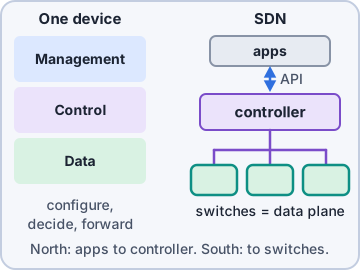
Exam tip Planes: data = forward, control = decide, management = configure. SDN = central control plane.
SD-WAN
SD-WAN applies SDN ideas to the wide area network. Each store gets an SD-WAN edge box that uses several links at once and a central controller decides the path. Four features to know; the first two:
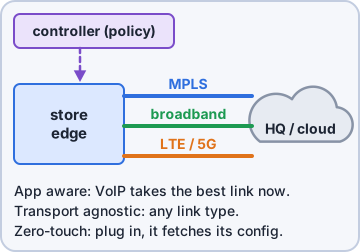
- Application aware: it identifies apps (VoIP, POS, video) and steers each one to the best link based on latency, jitter and loss.
- Zero-touch provisioning: ship the box to the store, plug it in, it calls home and downloads its config. No engineer on site.
SD-WAN: transport and policy
The other two SD-WAN features:
- Transport agnostic: it does not care if the link is MPLS, cable broadband, fiber or LTE/5G.
- Central policy management: one console sets routing and security policy for every site at once.
Exam tip Opening 20 stores with no IT staff on site? Zero-touch provisioning. Voice moves to the cleaner link automatically? Application aware.
Objective 1.8
VXLAN, zero trust and SASE/SSE
VXLAN
VXLAN (Virtual Extensible LAN) stretches Layer 2 segments across a Layer 3 network. It is Layer 2 encapsulation: original Ethernet frames are wrapped in UDP/IP (UDP port 4789) by VTEPs (tunnel endpoints) and routed anywhere. Its 24-bit VNI allows about 16 million segments versus 4,094 VLANs. Big uses: multi-tenant clouds and data center interconnect (DCI), so a VM can move between data centers and keep its IP.
Exam tip Need more than 4,094 segments, or the same Layer 2 network in two data centers over a routed link? VXLAN.
Zero trust architecture (ZTA)
Old model: inside the firewall = trusted. Zero trust (ZTA): never trust, always verify, no matter where the request comes from. Three ideas on the exam: policy-based authentication (identity plus context: device health, location, time, MFA, checked continuously), authorization for each request to each resource, and least privilege access (only the access the job needs, often with microsegmentation).
Exam tip Trap: zero trust does not mean "trust nothing so block everything". It means verify every request explicitly and grant the minimum.
SASE and SSE
SASE (Secure Access Service Edge) combines SD-WAN networking with cloud-delivered security in one service at provider points of presence near users: secure web gateway (SWG), cloud access security broker (CASB), zero trust network access (ZTNA) and firewall as a service. SSE (Security Service Edge) is just the security half of SASE without the SD-WAN part.
Exam tip SASE = SD-WAN + security, from the cloud. SSE = security only. Remote workers protected without backhauling to HQ = SASE/SSE.
Objective 1.8
Infrastructure as code (IaC)
IaC and automation
With infrastructure as code (IaC) you describe network and cloud config in text files and let tools apply it, so every build is repeatable. Automation pieces on the exam: playbooks (ordered steps to run, e.g. "configure a new store switch"), templates (a config with variables like VLAN or hostname) and reusable tasks (small blocks such as "set NTP" used by many playbooks).
# store-switch.yml (simplified)
- hosts: store_switches
  tasks:
    # reusable task
    - include: tasks/ntp.yml
    # template + vars
    - template: vlans.j2
      vars: {voice_vlan: 50, data_vlan: 20}
Exam tip IaC goal: the same input produces the same config every time, with no hand typing.
Drift, compliance, upgrades, dynamic inventories
Configuration drift happens when someone makes a manual change and a device no longer matches its approved baseline. IaC tools compare live config to the code, report drift and push it back into compliance. Upgrades: firmware rolled out to devices in automated, staged batches. Dynamic inventories build the target list live from a source (cloud API, IPAM, CMDB) in place of a hand-maintained static list, so new devices are included automatically.
Exam tip Exam: "device config no longer matches the standard after a manual change" = configuration drift.
Source control
IaC files live in source control (such as Git). Version control keeps every change: who, what, when, and rollback to any version. A central repository is the single source of truth everyone pulls from. Branching lets an engineer work on a change in a separate branch, test it, then merge after review. Conflict identification: if two people change the same lines, the merge is flagged as a conflict so a human decides instead of silently overwriting.
Exam tip Bad change broke the stores? Version control lets you revert to the last known good commit.
Check yourself 1Which is the correct shortened form of 2001:0db8:0000:0000:0001:0000:0000:00ab?
- 2001:db8::1::ab
- 2001:db8::1:0:0:ab
- 2001:db8:0:0:1::ab0
- 2001:0db8::1:ab
Show the answer
Answer: B. 2001:db8::1:0:0:ab
Drop leading zeros, then replace ONE run of zero groups with ::. 2001:db8::1:0:0:ab keeps 8 groups. Using :: twice is ambiguous and not allowed.
Check yourself 2Kibble wants new stores to come online by shipping an edge router that downloads its own config when plugged in, with no engineer on site. Which SD-WAN feature is this?
- Transport agnostic
- Application aware
- Zero-touch provisioning
- Central policy management
Show the answer
Answer: C. Zero-touch provisioning
Zero-touch provisioning lets a device contact the controller on first boot and pull its configuration automatically.
Practice questions
Answer in your head, then open the answer. Ranger's Packet Trail has 483 questions like these for Network+, with mock exams.
Question 1A company's SD-WAN edge devices build their overlay across MPLS, cable broadband and LTE links at the same time, treating any of these underlays the same way. Which SD-WAN characteristic does this describe?
- Zero-touch provisioning
- Transport agnostic
- Layer 2 encapsulation
- Application aware
Show the answer
Answer: B. Transport agnostic
Transport agnostic means SD-WAN can use any underlying WAN link type, such as MPLS, broadband or cellular. Zero-touch provisioning is about automatic setup of new devices.
Question 2A company wants its SD-WAN to recognize Microsoft Teams calls and send them over the lowest-latency link, while bulk file backups use the cheaper broadband link. Which SD-WAN capability makes this possible?
- Application-aware routing
- Transport agnostic design
- Dynamic inventories
- Zero-touch provisioning
Show the answer
Answer: A. Application-aware routing
Application-aware SD-WAN identifies traffic by application and steers it according to policy and link performance. Being transport agnostic just means it can use any link type.
Question 3A retailer ships SD-WAN appliances directly to 200 new stores. Store staff only plug in power and the internet cable, and each device then contacts the controller and downloads its configuration. What is this feature called?
- Zero-touch provisioning
- Configuration drift
- Central policy management
- Dual stack
Show the answer
Answer: A. Zero-touch provisioning
Zero-touch provisioning lets a new device configure itself automatically from a central controller with no on-site technician. Central policy management covers how policy is defined and pushed after the devices are set up.
Question 4In an SDN deployment, an engineer updates a security rule once in the controller, and the change is pushed to every switch and edge device automatically. Which concept is this?
- Zero-touch provisioning
- Transport agnostic design
- Data center interconnect
- Central policy management
Show the answer
Answer: D. Central policy management
SDN and SD-WAN separate the control plane into a central controller, so policy is defined once and pushed to all devices. Zero-touch provisioning covers first-time setup of new devices.
Question 5A company must stretch the same Layer 2 segment between two data centers so VMs can migrate between them without changing IP addresses. The data centers are connected only by a routed Layer 3 network. Which technology fits BEST?
- VXLAN
- 802.1Q trunking over the WAN
- NAT64 translation
- SD-WAN application routing
Show the answer
Answer: A. VXLAN
VXLAN carries Layer 2 frames inside UDP packets across a Layer 3 network, which makes it a common data center interconnect (DCI) solution. 802.1Q trunking needs a Layer 2 path, which a routed WAN doesn't provide.
CompTIA, A+, Network+, Security+ and Linux+ are trademarks of CompTIA, Inc. Ranger Gamez is not affiliated with or endorsed by CompTIA. The practice questions are written to the published exam objectives; they are not real exam questions.