 RANGER
CompTIA Tech+ (FC0-U71) · chapter 14 of 18
Data is kibble: why Mr. Barkley cares
In this chapter Objectives 5.1, 5.2
Objective 5.1
Data has value
Data as an asset
Data and information are assets: things of value a company protects and uses, like the warehouse or the trucks. Data becomes information when it's organized to answer a question, like sales by store. Critical data is data the business can't run without, like orders waiting to ship or customer accounts. Non-critical data is nice to have, like last year's party photos. Critical data gets the strongest protection and comes back first after an outage.
Mr. Barkley: The party photos are critical to me.
Maya: They can wait until the orders are back.
Data-driven decisions
Data-driven business decisions use facts instead of guesses. Three parts:
- Data capture and collection: gathering data on purpose, like a 'dog's breed' box at checkout or scans at the dock
- Data correlation: finding things that rise and fall together, like cold weeks and big-bag sales. Correlation doesn't prove one causes the other
- Meaningful reporting: showing the result so the reader can act on it, like one page of sales by store with a chart, not 40,000 raw rows
Mr. Barkley: So 'one page, one chart' is now official policy.
Analytics, big data and monetization
Data analytics examines data to find patterns, trends and the reasons behind them, like why some customers stop buying. Big Data means data so large, fast-arriving or varied, like every web click and sensor reading, that ordinary tools can't handle it. Data monetization means earning money or value from data: using purchase history to send offers that bring in sales, or selling anonymous, combined trend reports. It must follow privacy laws and the promises made to customers.
Check yourself 1Maya notices that weeks with more rain are also weeks with more online orders. What can she honestly tell Mr. Barkley?
- They're correlated; a test sale on rainy weeks could check it
- Rain causes online orders, so the store should plan around rain
- The data is meaningless because weather isn't business data
- Online orders cause rain
Show the answer
Answer: A. They're correlated; a test sale on rainy weeks could check it
The two rise together, which is correlation. Correlation doesn't prove cause, so a small test is the honest next step before betting money on it.
Objective 5.2
Why use a database?
Flat file vs. database
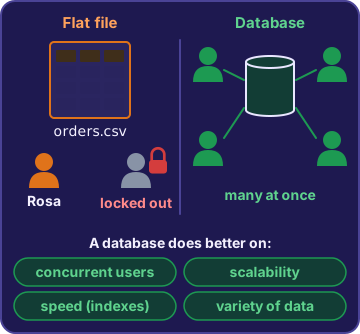
A flat file is one plain file of data, like a CSV file or a single spreadsheet. A database is an organized store of data run by database software. A database does better on:
- Multiple concurrent users: many people read and change data at the same time without locking each other out or overwriting edits
- Scalability: it keeps working as data grows from thousands of rows to millions
- Speed: indexes let a search jump straight to the matching rows
- Variety of data: numbers, dates, text and files kept together, each with its own rules
Exam tip A small list one person edits? A flat file is fine. Many users and growing data? Database.
What you do with a database
A record is one complete entry, like every detail of one order. Four everyday database uses:
- Create: build the database and its tables, like a new Products table
- Import/input: add data, by typing it into a form or importing a whole file at once
- Query: ask for exactly the data you need, like every order from Store 2 this week
- Reports: lay out query results as a readable summary with totals and charts
Theo: The payment service sends 400 payments a morning. We import the file. Nobody types 400 rows.
Persistence and availability
Data persistence means data stays saved after the app closes or the power goes off, because the database writes it to storage, not just memory. Data availability means being able to reach the data when you need it. Local data lives on a device or server in your building; cloud data lives on a provider's servers, reached over the internet. Online data needs a connection, while offline copies kept on your device still open when the internet is down.
Rosa: So my pick list should be an offline copy on my tablet. The dock Wi-Fi has moods.
Check yourself 2Mr. Barkley wants a neat page every Monday with last week's sales for each store, with totals and a chart. Which database use does that?
- Create
- Import
- Report
- Persistence
Show the answer
Answer: C. Report
A report lays out data, usually from a query, as a readable summary with totals and charts, ready to print or share.
Go deeper
More on the objectives in this chapter, in the same exam-ready detail.
Objective 5.1 · Data and information as an asset; Data-driven business decisions; Data monetization; Data analytics; Big Data
Why data is worth money
Data is an asset
An asset is something of value that a company protects and uses. Kibble & Co.'s order history helps plan stock, serve customers and earn money, so it's an asset just like the warehouse. Not all data matters equally. Critical data is data the business can't run without, like orders waiting to ship or the web store's order database. Non-critical data, like party photos or old marketing drafts, causes little harm if lost.
Exam tip After an outage, restore critical data first, even if a non-critical folder is smaller and quicker.
Data vs. information
Data is raw facts: order numbers, dates, bag counts. Information is data that has been organized and given meaning, so people can act on it: 'Store 2 sold 30% more large bags in December.' Both are assets, because good information comes from good data. That's why companies protect their data, check it for mistakes and keep backups of it.
Exam tip Rows in an export = data. A summary that answers a question = information.
Data-driven decisions
A data-driven decision uses real data, not guesses. Three steps help:
- Data capture and collection: gather new data, like asking 'What breed is your dog?' at checkout.
- Data correlation: notice that two things move together, like colder weeks and more large-bag sales. A correlation doesn't prove one causes the other: more late orders on days Ranger visits may just mean he visits on the busiest days.
- Meaningful reporting: a short summary by store with a chart that Mr. Barkley can read in five minutes, not a raw export.
Monetization, analytics and Big Data
Data monetization means earning money or value from data: selling anonymous, combined trend reports, or using purchase history to send offers that bring in sales. Data analytics means examining data to find patterns, trends and the reasons behind them, like why some customers stop buying. A report says what happened; analytics digs into why. Big Data is data so large, fast-arriving or varied that normal tools can't handle it, like millions of web clicks and sensor readings a day.
Exam tip A 200-row spreadsheet is useful data, but it isn't Big Data.
Objective 5.2 · Database uses; Flat file vs. database; Database records; Storage; Data availability
What a database does
Four database uses
What people do with a database:
- Create: build the tables and their fields, like a Products table with name, bag size and price.
- Import/input: bring data in. An import loads a whole file of payments at once, with no hand-typed typos.
- Query: ask for specific data, like every order from Store 2.
- Reports: format and summarize results, with totals and charts, to read or print. A report can use a query's results and shows the latest data each time it runs.
Flat file vs. database
A flat file keeps data in one simple file, like a spreadsheet or a comma-separated text list. A database wins on four counts:
- Multiple concurrent users: many people edit at once with no 'file locked' messages or overwritten changes.
- Scalability: keeps working as data grows to millions of records.
- Speed: indexes let a query jump straight to matches instead of reading line by line.
- Variety of data: each field has a type (number, date, text, even images).
Exam tip One person editing a 120-row list? A flat file is still fine.
Records and persistence
A record is one complete entry, like everything about a single order, shown as one row. Data persistence means data is written to storage, so it survives the app closing, a server restart or a power cut. Shopping carts kept only in the app's memory vanish on restart. Saving them in the database makes them persist, and adding more RAM wouldn't help.
Data availability
Can you reach the data when you need it?
- Local: on a device or server in your own building. Reachable without the internet.
- Cloud: on a provider's servers, reached over the internet from anywhere.
- Online vs. offline: files marked to always stay on your device open offline. Online-only cloud files need the internet to open.
Exam tip Internet outage coming? Mark the files you need to stay on your device first.
Practice questions
Answer in your head, then open the answer. Ranger’s First Byte has 455 questions like these for Tech+, with mock exams.
Question 1Mr. Barkley says Kibble & Co.'s order history is an asset, just like the warehouse. What does he mean?
- Data only matters to the IT team, not the business
- Every piece of company data is equally important
- The data has value, so the company protects and uses it
- Data only has worth once someone pays the company for it
Show the answer
Answer: C. The data has value, so the company protects and uses it
An asset is something of value. Order history helps Kibble & Co. plan stock, serve customers and make money, so it is protected like any valuable thing. Calling data an asset does not mean all data is equally critical.
Question 2Which of these is critical data for Kibble & Co.?
- Customer orders waiting to ship
- Photos from the office holiday party
- The break room's lunch sign-up sheet
- Old drafts of a poster for the lobby
Show the answer
Answer: A. Customer orders waiting to ship
Critical data is data the business cannot run without. If waiting orders were lost, customers would not get their kibble. Party photos, a lunch list and old drafts are non-critical: losing them causes little harm.
Question 3Theo adds a question at checkout on the online kibble store: "What breed is your dog?" The answers are saved with each order. Which data activity is this?
- Data correlation
- Data capture and collection
- Data monetization
- Meaningful reporting
Show the answer
Answer: B. Data capture and collection
Asking customers a question and saving their answers is data capture and collection: gathering new data to use later. Correlation would come later, if Theo compared breeds with what customers buy.
Question 4Maya's chart shows that in colder weeks, the online kibble store sells more large bags of kibble. What is Maya doing when she finds this link between two sets of data?
- Data capture
- Data persistence
- Big data
- Data correlation
Show the answer
Answer: D. Data correlation
Correlation means finding that two sets of data move together, like colder weeks and sales of large bags. Capture only gathers the data; Maya already has it and is comparing it.
Question 5Rosa sees that on days Ranger visits the warehouse, more orders ship late. She wants to ban Ranger from the warehouse. What should Maya point out before Rosa decides?
- The data proves that Ranger causes the delays
- The two are correlated, but that does not prove Ranger causes delays
- Late shipments belong in a report, not in an analysis
- This data is too small to count, since only big data can show any patterns
Show the answer
Answer: B. The two are correlated, but that does not prove Ranger causes delays
The data shows a correlation: Ranger's visits and late orders happen on the same days. That does not prove Ranger causes the delays. Maybe Ranger comes in on the busiest days. Rosa should check other data before deciding.
CompTIA, Tech+, A+, Network+, Security+ and Linux+ are trademarks of CompTIA, Inc. Ranger Gamez is not affiliated with or endorsed by CompTIA. The practice questions are written to the published exam objectives; they are not real exam questions.