 RANGER
AWS Certified Cloud Practitioner (CLF-C02) · chapter 2 of 14
Build it right: six pillars
In this chapter Objectives 1.2
Objective 1.2
The AWS Well-Architected Framework
Best practices, written down
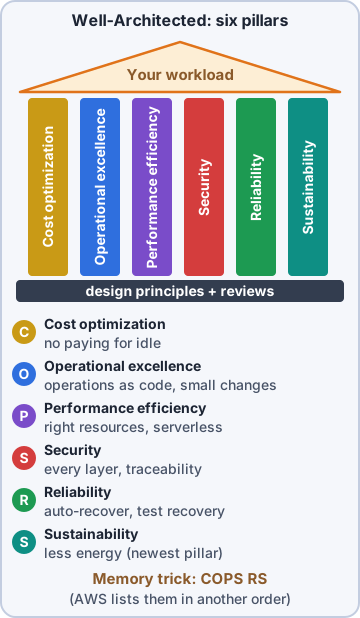
The AWS Well-Architected Framework is AWS's collection of design principles, best practices and review questions for building and running workloads in the cloud. It is organized into six pillars. Teams use the free AWS Well-Architected Tool in the console to answer the questions for one workload and get a list of risks to fix. It's a review guide, not a service that changes anything for you.
Exam tip Trap: the Well-Architected Tool reviews a design and reports risks. It doesn't scan resources or fix them; that's Trusted Advisor and other services.
Operational excellence: run it and improve it
Operational excellence is about running and monitoring systems to deliver business value, and improving the processes that support them. Its design principles include: safely automate where possible (operations as code), make frequent small reversible changes, refine procedures often, anticipate failure, and learn from every operational event.
Dev: Small changes you can undo beat one giant Friday-night change you can't.
Security: protect data, systems and assets
The security pillar covers protecting information and systems. Principles: build a strong identity foundation (least privilege), turn on traceability (log and monitor who did what), apply security at all layers, automate security best practices, protect data in transit and at rest, keep people away from data where possible, and prepare for security events.
Priya: Every one of those becomes a chapter later. Remember "identity first, then logs".
Check yourself 1In a design review, Dev proposes making many small, reversible changes to the shop through automated templates instead of one big manual release each quarter. Which pillar does this practice belong to?
- Cost optimization
- Sustainability
- Operational excellence
- Performance efficiency
Show the answer
Answer: C. Operational excellence
Operations as code and frequent, small, reversible changes are design principles of the operational excellence pillar.
Objective 1.2
Four more pillars
Reliability: work correctly, recover quickly
Reliability is a workload's ability to perform its intended function correctly and consistently, and to recover from failures. Principles: automatically recover from failure, test recovery procedures, scale horizontally (many small resources instead of one big one, so one failure hurts less), stop guessing capacity, and manage change through automation.
Exam tip Words that point to reliability: recover, failover, withstand a failure, backups tested, multiple Availability Zones.
Performance efficiency: the right resource for the job
Performance efficiency means using computing resources efficiently to meet requirements, and staying efficient as demand and technology change. Principles: use advanced technologies as managed services, go global in minutes, use serverless architectures, experiment more often, and pick the tool that fits the job (AWS calls it "mechanical sympathy").
Ranger: chooses the softest dog bed in the room Woof.
You: Right resource for the job. He gets it.
Cost optimization: value at the lowest price
Cost optimization is running systems that deliver business value at the lowest price point. Principles: practice cloud financial management, adopt a consumption model (pay only for what you use), measure overall efficiency, stop spending money on undifferentiated heavy lifting (let AWS run data centers), and analyze and attribute spending so each team sees its bill.
Sustainability: less impact on the planet
Sustainability, the newest pillar, is about reducing the environmental impact of running cloud workloads. Principles: understand your impact, set goals, maximize utilization (no idle servers burning power), adopt newer more efficient hardware and software, use managed services, and reduce the energy needed by your users' devices and downstream systems.
Exam tip Cost and sustainability often agree (turning off idle servers helps both). Pick sustainability when the question talks about energy, carbon or environmental goals.
Check yourself 2Kibble & Co. sets a goal to cut the energy used by its cloud workloads, and Dev plans to raise average server use so fewer servers sit idle. Which pillar is the primary focus?
- Sustainability
- Reliability
- Security
- Operational excellence
Show the answer
Answer: A. Sustainability
Maximizing utilization to reduce energy use and environmental impact is a core sustainability design principle. It saves money too, but the stated goal is energy.
Objective 1.2
Identifying differences between the pillars
Pairs that look alike
Ask "what is this practice protecting against?" and the pillar usually jumps out.
- Reliability vs performance efficiency: surviving and recovering from failure vs using the right, efficient resources for the load
- Cost optimization vs sustainability: money vs environmental impact, even when one action helps both
- Operational excellence vs reliability: how you run, monitor and improve operations vs how the workload withstands failure
- Security vs operational excellence: protecting data and access vs running changes and procedures well
Exam tip If two pillars both fit, choose the one the question's goal names: "recover", "faster", "cheaper", "greener", "auditable", "fewer manual steps".
Why AWS cares about all six
The pillars trade off. Running the shop in three Availability Zones raises reliability but costs more. Rightsizing cuts cost but could hurt performance if you shrink too far. A Well-Architected review makes these trade-offs on purpose instead of by accident, and you repeat it as the business changes.
Dev: Nobody aces all six on day one. We review, fix the high risks, and review again next quarter.
Check yourself 3Which practices belong to the reliability pillar? Choose two.
- Testing how the shop recovers when a server fails
- Tagging resources so each team sees its own costs
- Scaling out across many small servers instead of one large one
- Selecting a newer instance type that does more work per watt
- Requiring multi-factor authentication (MFA) for every administrator
Show the answer
Answers: A. Testing how the shop recovers when a server fails, C. Scaling out across many small servers instead of one large one
Reliability principles include testing recovery procedures and scaling horizontally so one failure has a small effect.
Practice questions
Answer in your head, then open the answer. Ranger's Cloud Kennel has 563 questions like these for AWS Cloud Practitioner, with mock exams.
Question 1Which pillar of the AWS Well-Architected Framework focuses on running and monitoring systems and continually improving processes and procedures?
- Reliability
- Performance efficiency
- Operational excellence
- Security
Show the answer
Answer: C. Operational excellence
Operational excellence covers how you run and monitor workloads, automate changes, respond to events and improve procedures over time. Reliability is about the workload itself recovering and working consistently.
Question 2Which Well-Architected pillar focuses on protecting data, systems, and assets, including controlling who can do what?
- Reliability
- Security
- Cost optimization
- Sustainability
Show the answer
Answer: B. Security
The security pillar covers identity and access, detection, infrastructure and data protection, and incident response. Reliability is about the workload working correctly and recovering from failures.
Question 3Which Well-Architected pillar is about a workload performing its intended function correctly and consistently, and recovering quickly from failures?
- Reliability
- Operational excellence
- Performance efficiency
- Security
Show the answer
Answer: A. Reliability
Reliability is the ability of a workload to do what it should when expected, including automatically recovering from failures. Operational excellence is about how teams run and improve operations.
Question 4Which Well-Architected pillar focuses on using computing resources efficiently to meet requirements, and keeping that efficiency as demand and technology change?
- Cost optimization
- Reliability
- Operational excellence
- Performance efficiency
Show the answer
Answer: D. Performance efficiency
Performance efficiency is about selecting the right resource types and sizes and keeping them right as needs evolve. Cost optimization looks at the same resources from the angle of avoiding unnecessary spend.
Question 5Which Well-Architected pillar focuses on avoiding unnecessary spending and delivering business value at the lowest price point?
- Performance efficiency
- Sustainability
- Cost optimization
- Operational excellence
Show the answer
Answer: C. Cost optimization
Cost optimization is about understanding spending, choosing the right pricing models, and removing waste. Sustainability often lowers costs as well, but its goal is reducing environmental impact.
AWS and Amazon Web Services are trademarks of Amazon.com, Inc. or its affiliates. Ranger Gamez is not affiliated with or endorsed by Amazon. The practice questions are written to the published exam objectives; they are not real exam questions.