 RANGER
AWS Certified Cloud Practitioner (CLF-C02) · chapter 3 of 14
The moving plan
In this chapter Objectives 1.3
Objective 1.3
The AWS Cloud Adoption Framework
A plan for the whole company, not just IT
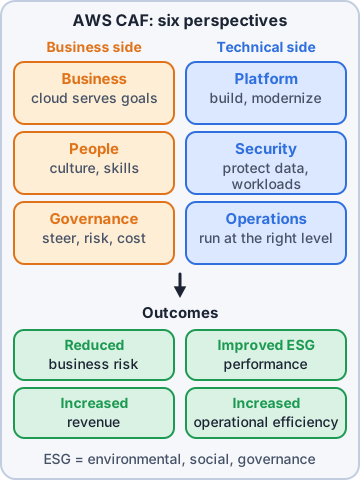
The AWS Cloud Adoption Framework (AWS CAF) is AWS guidance that helps an organization plan and speed up its move to the cloud. It groups the needed capabilities into six perspectives. Three are business-focused (business, people, governance) and three are technical (platform, security, operations). Each perspective is owned by different people, from the CEO to the operations team.
Exam tip Exam pattern: a question names a group (HR, finance, security chief, architects) and asks which CAF perspective. Match the people to the perspective.
The four business outcomes
AWS says cloud adoption with the CAF improves four business outcomes. The exam guide lists them by name, so learn them word for word.
- Reduced business risk: better reliability, security and recovery
- Improved environmental, social and governance (ESG) performance: for example, using more energy-efficient data centers
- Increased revenue: new products and customers, faster
- Increased operational efficiency: lower costs, more automation, more productive staff
Objective 1.3
Six perspectives, six owners
The business-side perspectives
These three make sure the move pays off for the company and its people.
- Business perspective: cloud investments speed up business outcomes (strategy, product and portfolio, data monetization). Owners: CEO, CFO, business leaders.
- People perspective: culture, training, staffing and change, so people are ready. Owners: HR, people leaders.
- Governance perspective: run the program, manage risk, cost and benefits. Owners: program managers, finance, risk.
The technical perspectives
These three build, protect and run what the business side planned.
- Platform perspective: a scalable, well-built cloud platform and architecture, including modernizing apps. Owners: architects, engineers.
- Security perspective: confidentiality, integrity and availability of data and workloads. Owners: the chief information security officer (CISO) and security team.
- Operations perspective: cloud services run and are delivered at the agreed level. Owners: IT operations, support.
Priya: Security is its own perspective. I have it framed above my desk.
Maya: And I'm on people. Training is my job.
Check yourself 1Maya plans cloud training for the help desk and works with HR on new job roles for the move. Which AWS CAF perspective covers this work?
- Governance
- Operations
- People
- Platform
Show the answer
Answer: C. People
The people perspective covers culture, training, staffing and organizational change so the workforce is ready for the cloud.
Check yourself 2Mr. Barkley asks which benefit the board will see if the move lets Kibble & Co. launch a subscription kibble service months sooner. Which AWS CAF outcome is that?
- Reduced business risk
- Improved ESG performance
- Increased operational efficiency
- Increased revenue
Show the answer
Answer: D. Increased revenue
Launching new products and reaching customers faster grows sales: the increased revenue outcome.
Objective 1.3
Migration strategies: the seven Rs
Seven ways to handle each app
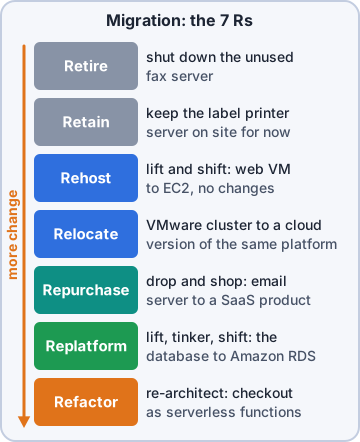
AWS describes seven migration strategies, the 7 Rs. Each app in the inventory gets one. They run from "do nothing" to "rebuild it for the cloud".
- Retire: switch it off; nobody needs it
- Retain: keep it where it is for now (revisit later)
- Rehost ("lift and shift"): move servers as they are to Amazon Elastic Compute Cloud (Amazon EC2)
- Relocate: move a whole virtualized environment (for example VMware) to the cloud with no app changes
- Repurchase ("drop and shop"): switch to a software as a service (SaaS) product
- Replatform ("lift, tinker and shift"): small changes, such as moving a database to a managed service
- Refactor (re-architect): rebuild the app with cloud-native features
Picking the right R
Rehost is fastest and changes the least, but gets the fewest cloud benefits. Refactor takes the most work but gives the most: elasticity, serverless, managed services. Replatform sits between: a few targeted changes, like moving the stock database to Amazon Relational Database Service (Amazon RDS) so AWS handles patching and backups, without rewriting the app.
Exam tip Trap: "replatform" makes small optimizations without changing the core app. "Refactor" changes the app's architecture. "Repurchase" replaces it with a different product.
Check yourself 3The fax-to-email box hasn't received a fax in two years and nobody owns it. Which migration strategy fits?
- Rehost
- Retire
- Retain
- Repurchase
Show the answer
Answer: B. Retire
Retiring apps nobody uses is often the quickest win of a migration: less to move, less to pay for.
Objective 1.3
Moving data and getting help
Database replication keeps the shop open
Moving a busy database is risky: you can't stop taking orders for a day. With database replication, a copy of the database runs in AWS and stays in sync with the original while customers keep shopping. When the copy is caught up, you switch the shop over in minutes. AWS Database Migration Service (AWS DMS) does this continuous replication, and the source database stays fully usable during the move.
Exam tip If a question says "migrate with minimal downtime" or "the source must stay operational", think database replication with AWS DMS. More in the database chapter.
Resources for the migration journey
AWS gives tools and people for each stage of the move.
- AWS Application Discovery Service: finds on-premises servers, their use and their dependencies
- Migration Evaluator: builds a business case with projected cloud costs
- AWS Application Migration Service: rehosts (lift and shift) servers to AWS with little downtime
- AWS Migration Hub: one place to track a migration's progress (closed to new customers since Nov 2025; AWS Transform is its successor)
- AWS Prescriptive Guidance: AWS-written strategies, guides and patterns for migrations
- People: AWS Professional Services and AWS Partners can plan and run the move with you
Maya: Migration Evaluator is how we'll show Mr. Barkley the numbers before we spend a cent.
Check yourself 4Dev needs a list of every server in the closet, how busy each one is and which servers talk to each other, before choosing a strategy. Which service helps most?
- AWS Application Migration Service
- AWS Database Migration Service
- AWS Application Discovery Service
- AWS Well-Architected Tool
Show the answer
Answer: C. AWS Application Discovery Service
Application Discovery Service collects server configuration, use and dependency data to plan a migration.
Go deeper
More on the objectives in this chapter, in the same exam-ready detail.
Objective 1.3 · Cloud adoption strategies
Cloud adoption: the AWS Cloud Adoption Framework
A plan, not just servers
Moving to the cloud changes people and processes as well as technology. The AWS Cloud Adoption Framework (AWS CAF) organizes the work into six perspectives, each owned by different stakeholders.
- Business: the business case and outcomes (business leaders, CFO)
- People: skills, training and culture change (HR, managers)
- Governance: risk, cost and program management (CIO, program managers)
- Platform: the technical architecture (CTO, architects)
- Security: confidentiality, integrity, availability (CISO)
- Operations: running and supporting workloads (IT operations)
How adoption progresses
AWS CAF describes four phases that repeat as you grow: Envision (where the cloud helps the business), Align (find gaps across the six perspectives), Launch (deliver pilots to production) and Scale (expand them). The benefits AWS lists: reduced business risk, improved ESG performance, increased revenue and increased operational efficiency.
Exam tip Business, People, Governance = business capabilities; Platform, Security, Operations = technical capabilities.
Objective 1.3 · Identifying appropriate migration strategies (for example, database replication)
Migration strategies: the 7 Rs
The seven Rs
AWS describes seven common ways to move each application:
- Retire: switch it off; nobody needs it
- Retain: keep it on-premises for now
- Rehost ('lift and shift'): move the VM as is, for example to Amazon EC2
- Relocate: move a whole VMware environment (for example VMware Cloud on AWS) without changing it
- Replatform ('lift, tinker and shift'): small changes, such as moving a self-managed database to Amazon RDS
- Repurchase: switch to a SaaS product
- Refactor / re-architect: rebuild it cloud-native (for example containers or AWS Lambda)
Moving the data
Databases usually move with AWS Database Migration Service (AWS DMS), which copies the data and keeps replicating changes so the old and new databases stay in sync until you cut over with little downtime. Large data sets that would take too long over the internet go on AWS Snowball devices; ongoing transfers use AWS DataSync.
- Real-world change: AWS no longer sells Snow Family devices to new customers (it points them to AWS Data Transfer Terminals or partners). The exam answer for huge offline transfers is still Snowball
Exam tip Fastest move, no code changes: rehost. Least operational work afterwards: refactor or repurchase.
Objective 1.3 · Migration and data transfer
Migration and data transfer services
The services
Services that move servers, databases and files into AWS:
- AWS Application Migration Service (AWS MGN): rehost (lift-and-shift) servers to EC2
- AWS Database Migration Service (AWS DMS): move databases with little downtime
- AWS DataSync: online transfer of files between on-premises storage and AWS
- AWS Snow Family (Snowball Edge): rugged devices to ship large amounts of data offline
- AWS Transfer Family: managed SFTP/FTPS/FTP into S3 or EFS
- AWS Migration Hub: track migration progress (closed to new customers since November 2025; AWS Transform replaces it, but the exam still names Migration Hub)
- AWS Application Discovery Service: inventory on-premises servers before migrating
Choosing
Huge data set, slow internet = Snowball (exam answer; not sold to new customers anymore). Ongoing file sync over the network = DataSync. Servers as they are = Application Migration Service. Partners send files by SFTP = Transfer Family.
Practice questions
Answer in your head, then open the answer. Ranger's Cloud Kennel has 563 questions like these for AWS Cloud Practitioner, with mock exams.
Question 1What is the AWS Cloud Adoption Framework (AWS CAF)?
- A service that copies on-premises servers to Amazon EC2
- A tool that estimates the monthly cost of AWS resources
- A library of AWS compliance reports and agreements
- Guidance for planning and speeding up a cloud transformation
Show the answer
Answer: D. Guidance for planning and speeding up a cloud transformation
The AWS CAF uses AWS experience and best practices to help organizations build the capabilities they need for a successful cloud transformation. It is guidance organized into six perspectives, not a migration tool.
Question 2Which AWS CAF perspective focuses on culture, leadership, training, and preparing staff for new ways of working in the cloud?
- Governance
- Operations
- People
- Business
Show the answer
Answer: C. People
The people perspective bridges technology and business, covering culture, leadership, cloud fluency and workforce transformation. Governance covers programs, risk and cloud finance.
Question 3Which AWS CAF perspective makes sure cloud investments speed up digital transformation and business outcomes, and commonly involves the CEO and CFO?
- Business
- Platform
- People
- Security
Show the answer
Answer: A. Business
The business perspective covers strategy, portfolio and product management, and data-driven insights, so that cloud spending serves business goals. Its stakeholders include the CEO, CFO, COO and CIO.
Question 4Which AWS CAF perspective covers program and project management, benefits tracking, risk management, and cloud financial management?
- Business
- Governance
- Operations
- People
Show the answer
Answer: B. Governance
The governance perspective helps orchestrate cloud initiatives while maximizing benefits and minimizing transformation risk, including cloud financial management. Business sets strategy; governance controls the program.
Question 5Which AWS CAF perspective focuses on building a scalable hybrid cloud platform, modernizing workloads, and delivery practices such as CI/CD?
- Platform
- Operations
- Governance
- Business
Show the answer
Answer: A. Platform
The platform perspective covers platform and data architecture, engineering, provisioning, and modern application development including continuous integration and continuous delivery (CI/CD).
AWS and Amazon Web Services are trademarks of Amazon.com, Inc. or its affiliates. Ranger Gamez is not affiliated with or endorsed by Amazon. The practice questions are written to the published exam objectives; they are not real exam questions.