 RANGER
AWS Certified Cloud Practitioner (CLF-C02) · chapter 4 of 14
Whose job is it?
In this chapter Objectives 2.1
Objective 2.1
The AWS shared responsibility model
Security OF the cloud vs security IN the cloud
The AWS shared responsibility model splits security work between AWS and the customer. AWS is responsible for security of the cloud: the buildings, hardware, network and software that run AWS services. The customer is responsible for security in the cloud: what they put in AWS and how they configure it. Think of a rented kennel: the owner keeps the walls and locks sound; you decide who gets a key and you look after your own dog.
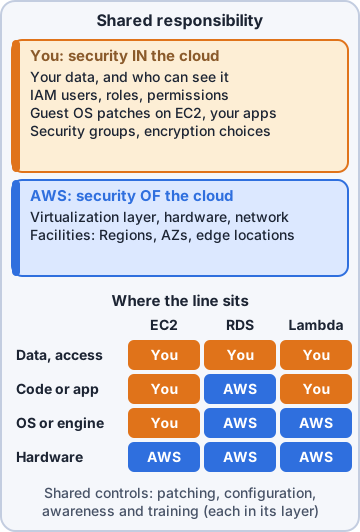
Exam tip Memory hook: AWS = OF, customer = IN. If a question says "physical", "facilities" or "hypervisor", it's AWS.
What AWS is responsible for
AWS protects the infrastructure every customer shares.
- Physical security of data centers: guards, cameras, access control
- Hardware: servers, storage, networking gear, and disposing of old disks securely
- The global infrastructure: Regions, Availability Zones and edge locations
- The virtualization layer (hypervisor) that separates one customer's servers from another's
- The software that runs managed services, such as the operating system under Amazon Relational Database Service (Amazon RDS) or AWS Lambda
What the customer is responsible for
The customer protects everything it builds and stores in AWS.
- Customer data, including classifying it and choosing to encrypt it
- Identity and access: users, passwords, multi-factor authentication (MFA), permissions (IAM)
- On virtual servers such as Amazon Elastic Compute Cloud (Amazon EC2): the guest operating system (OS), its patches and the apps on it
- Network and firewall settings, such as security group rules
- Encryption choices: client-side and server-side encryption, and protecting data in transit
Priya: Data and access are always ours. Always. No service changes that.
Check yourself 1According to the AWS shared responsibility model, which task is AWS's responsibility?
- Setting the shop's security group rules
- Encrypting customer order data in Amazon Simple Storage Service (Amazon S3)
- Securing the physical data centers that run Amazon EC2
- Creating IAM users for new staff
Show the answer
Answer: C. Securing the physical data centers that run Amazon EC2
Physical security of the facilities is part of security OF the cloud, which AWS owns. The other three are things the customer configures IN the cloud.
Objective 2.1
Shared controls
Some controls belong to both
A few controls are shared controls: each side does its own part, in its own layer.
- Patch management: AWS patches the infrastructure; the customer patches its guest operating systems and apps
- Configuration management: AWS configures its infrastructure devices; the customer configures its own OS, databases and apps
- Awareness and training: AWS trains AWS staff; the customer trains its own staff
Inherited controls
Some controls the customer simply inherits from AWS, such as physical and environmental controls (fire suppression, power, flood protection). Kibble & Co. can point an auditor to AWS's reports for those instead of proving them itself. You'll see where to get those reports soon.
Exam tip Trap: patching is shared, not "all AWS". The exam often asks who patches the guest OS on an EC2 instance: that's the customer.
Check yourself 2Which statement about patch management in the shared responsibility model is correct?
- AWS patches every operating system running on AWS
- The customer patches the physical host servers
- Patching is never part of the model
- AWS patches its infrastructure; the customer patches its guest OS and apps
Show the answer
Answer: D. AWS patches its infrastructure; the customer patches its guest OS and apps
Patch management is a shared control: each side patches its own layer.
Objective 2.1
How the line shifts by service
Amazon EC2: you manage the most
Amazon Elastic Compute Cloud (Amazon EC2) gives you virtual servers. AWS secures the hardware and hypervisor. Everything from the guest operating system up is yours: patches, installed software, the app, firewall rules, data. This model is called infrastructure as a service (IaaS).
Amazon RDS: AWS takes the OS and engine
With Amazon RDS, the managed database you met in the moving plan, AWS also patches the operating system and database engine, and runs automated backups. You still manage the data, database users and permissions, which networks can connect, and whether to turn on encryption. Managed services like this are close to platform as a service (PaaS).
Sam: So no 2 a.m. database patching. I could hug someone.
Ranger: volunteers
AWS Lambda: you bring code and data
AWS Lambda runs your code without servers to manage. AWS handles the OS, the runtime, scaling and availability. The customer is responsible for the code, the data it touches, and the IAM permissions it runs with. At the far end, software as a service (SaaS) apps leave the customer mostly data and access to manage.
Exam tip Rule: the more managed the service, the more AWS does. But data, access and permissions stay with the customer every time.
Check yourself 3Kibble & Co. moves its stock database from an EC2 instance to Amazon RDS. Which responsibility moves from Kibble & Co. to AWS?
- Deciding which staff can read stock data
- Patching the database engine and its operating system
- Choosing whether to encrypt the database
- Writing the queries the shop uses
Show the answer
Answer: B. Patching the database engine and its operating system
On EC2 the customer patches the OS and database engine. On RDS, AWS does it. Data, access and encryption choices stay with the customer.
Go deeper
More on the objectives in this chapter, in the same exam-ready detail.
Objective 2.1 · Describing AWS responsibilities
Shared responsibility: AWS's half
Security OF the cloud
AWS is responsible for security of the cloud: the infrastructure that runs every service.
- Physical data centers: buildings, guards, power, cooling
- Hardware: servers, storage, network devices, and disposing of old disks safely
- The global network and the virtualization layer (hypervisor)
- The software of managed services (for example the database engine patching in Amazon RDS)
- Regions, Availability Zones and edge locations
Security IN the cloud
The customer is responsible for security in the cloud: their data, who can access it (IAM), how it's encrypted, network rules (security groups, network ACLs), and the guest operating system and apps on services where they control them (such as EC2).
Exam tip Physical security of a data center is always AWS. Customer data and IAM users are always the customer.
Objective 2.1 · Describing how AWS responsibilities and customer responsibilities can shift, depending on the service used…
How the line moves: EC2 vs RDS vs Lambda
The more managed, the less you do
The split depends on how much of the stack AWS runs for you.
- Amazon EC2 (infrastructure): you patch the guest OS, install and update software, configure the firewall (security groups) and protect the data
- Amazon RDS (managed database): AWS patches the OS and database engine and runs backups; you manage database users, network access, encryption settings and your data
- AWS Lambda (serverless): AWS runs the servers, OS and runtime; you're responsible for your function code, its IAM permissions and your data
- Amazon S3: AWS runs the storage; you set bucket policies, encryption and who can access objects
Shared controls
Some controls are shared: patch management (AWS patches infrastructure, you patch your OS/apps), configuration management and awareness and training (each side trains its own people).
Exam tip Who patches the OS? EC2 = customer. RDS and Lambda = AWS.
Practice questions
Answer in your head, then open the answer. Ranger's Cloud Kennel has 563 questions like these for AWS Cloud Practitioner, with mock exams.
Question 1Kibble & Co. runs its order website on Amazon EC2 instances. A new security patch for the instances' Linux operating system was released this week. Under the AWS shared responsibility model, who must apply it?
- Kibble & Co., the customer
- AWS, as part of security of the cloud
- AWS Support, once a support case is opened
- The maker of the physical server hardware
Show the answer
Answer: A. Kibble & Co., the customer
On Amazon EC2 the customer owns the guest operating system, including its patches. AWS is responsible for the hardware and the virtualization layer underneath it.
Question 2An auditor asks who makes sure that failed storage drives from AWS data centers are wiped or destroyed before they leave the building. Under the AWS shared responsibility model, whose job is this?
- The customer whose data was on the drive
- Both parties equally, as a shared control
- The AWS Partner that resold the account
- AWS, as part of security of the cloud
Show the answer
Answer: D. AWS, as part of security of the cloud
Physical hardware, including secure disposal of storage media, is part of security OF the cloud, which AWS owns. Customers can't touch the hardware, so it can't be a shared or customer task.
Question 3Which part of an Amazon EC2 environment does AWS secure and maintain under the shared responsibility model?
- The guest operating system installed on each instance
- The security group rules attached to the instances
- The hypervisor that isolates customer instances
- The application code deployed on the instances
Show the answer
Answer: C. The hypervisor that isolates customer instances
The virtualization layer (hypervisor) is AWS infrastructure, so AWS secures it. Everything from the guest operating system up, including security groups and code, is the customer's.
Question 4Which responsibility stays with the customer no matter which AWS service it uses?
- Patching the operating system of the physical hosts
- Controlling who can access the customer's data
- Maintaining the network links between Availability Zones
- Replacing failed disks in AWS storage systems
Show the answer
Answer: B. Controlling who can access the customer's data
Data and access management stay with the customer for every service, from Amazon EC2 to AWS Lambda. The infrastructure items are always AWS's.
Question 5Kibble & Co. moves its MySQL database from an Amazon EC2 instance to Amazon RDS. Which task moves from Kibble to AWS?
- Patching the database engine and the operating system under it
- Creating database user accounts and passwords for the staff who use it
- Deciding which networks can connect to the database
- Choosing whether to encrypt the database
Show the answer
Answer: A. Patching the database engine and the operating system under it
With Amazon RDS, AWS takes over the operating system and database engine patching that Kibble did on EC2. Kibble still manages data, database users, network access and the choice to encrypt.
AWS and Amazon Web Services are trademarks of Amazon.com, Inc. or its affiliates. Ranger Gamez is not affiliated with or endorsed by Amazon. The practice questions are written to the published exam objectives; they are not real exam questions.