 RANGER
CompTIA A+ Core 2 (220-1202) · chapter 15 of 17
Ops: Safe hands in the warehouse
In this chapter Objectives 4.4, 4.5, 4.7
Objective 4.4
Safety procedures
Electrostatic discharge (ESD)
Static you can't even feel can damage chips. Protect components:
- ESD straps: wrist strap clipped to the PC's unpainted metal frame (or the mat's ground) so you and the PC are at the same potential
- ESD mats: grounded work surface for parts and the PC
- Antistatic bags: store and carry boards, RAM and drives in them; never set a part ON top of the bag's outside
- Proper component handling and storage: hold cards by the edges, avoid touching pins, store in a cool, dry place
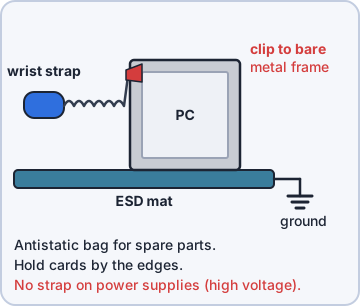
Exam tip Clip the ESD strap to bare metal on the chassis, not to painted panels or plastic.
Electrical safety
Equipment grounding: grounded outlets and three-prong plugs carry fault current away from you. Disconnect power before repairing a PC: unplug it (and remove the laptop battery if possible). Never open a power supply or a monitor's power section; capacitors hold a dangerous charge even when unplugged.
Exam tip Don't wear an ESD strap when working on high-voltage parts like power supplies. You WANT isolation there.
Personal safety and cables
Protect yourself and others:
- Lifting techniques: bend at the knees, keep your back straight, hold the load close, and get help or a cart for heavy items
- Fire safety: use a Class C (electrical) extinguisher such as CO2 on electrical fires, never water; know the exits
- Safety goggles when cutting, crimping or using compressed air; an air filter mask for dust and toner
- Cable management: route and secure cables to prevent trip hazards and strain
Compliance with government regulations
Workplace safety laws (in the US, OSHA rules) and local electrical and fire codes set requirements: training, labeling, protective equipment, how chemicals are stored. Company safety policy builds on them, and you follow both.
Exam tip If a question asks what to follow first on safety, the answer is the law/local regulations, then company policy.
Check yourself 1A UPS in the warehouse closet starts smoking, and a small flame appears. Which extinguisher should you use?
- A pressurized water extinguisher
- A Class A extinguisher for paper
- A bucket of sand from the dock
- A CO2 Class C extinguisher
Show the answer
Answer: D. A CO2 Class C extinguisher
Electrical fires need a Class C extinguisher, such as CO2, which does not conduct electricity. Never use water on electrical equipment.
Objective 4.5
Environmental impacts and controls
Safety data sheets and disposal
Material safety data sheets (MSDS), now often called SDS, describe a product's hazards, safe handling and disposal, and first aid. Read one before cleaning up a chemical or toner spill.
- Proper battery disposal: recycle lithium-ion and other batteries through approved programs; never trash them
- Proper toner disposal: return or recycle cartridges; clean spills with a toner vacuum, not a regular one
- Proper disposal of other devices and assets: e-waste goes to certified recyclers, following local rules
Temperature, humidity and airflow
Equipment likes cool, steady and clean conditions:
- Temperature: heat shortens component life and causes shutdowns
- Humidity-level awareness: too dry = static (ESD); too humid = condensation and corrosion; aim for moderate levels (around 50%)
- Proper ventilation: clear airflow in and out of racks and cases
- Location/equipment placement: away from windows, heaters, water pipes and floor-level dust
- Dust cleanup: compressed air blows dust out (outside or with a mask); an electronics-safe vacuum picks it up
Power problems
Know the three problems and the two fixes:
Problem      Effect        Protection
Power surge  brief spike   surge suppressor
Brownout     voltage sags  UPS
Blackout     power lost    UPS

UPS = battery backup + time to
      shut down safely
Surge suppressor = absorbs spikes;
      no battery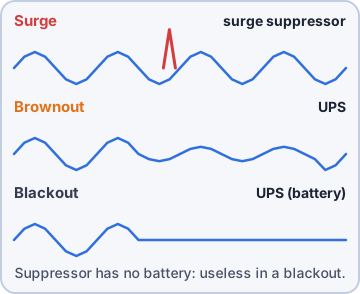
Exam tip A surge suppressor doesn't help in a blackout. Only a UPS keeps devices running.
Check yourself 2A tech is about to replace RAM in a desktop on a carpeted floor in winter. Which is the BEST way to prevent ESD damage?
- Keep the PC plugged in and powered on
- Wear a wrist strap clipped to the bare chassis
- Wear rubber-soled shoes while working
- Lay the RAM on the outside of its antistatic bag
Show the answer
Answer: B. Wear a wrist strap clipped to the bare chassis
A grounded ESD strap on bare metal keeps you and the PC at the same potential. Never work inside a powered PC.
Objective 4.7
Communication and professionalism
How you show up
Professionalism is tested on the exam, and it's half the job.
- Present a professional appearance: match the setting's attire: formal for executive meetings, business casual for most office visits
- Use proper language: avoid jargon, acronyms and slang
- Maintain a positive attitude: project confidence, even when you need to look something up
- Be on time (punctuality); contact the customer if you'll be late
- Be culturally sensitive: use professional titles and designations (Dr., Mr. Barkley) and respect differences
Listening and difficult customers
Actively listen: take notes and avoid interrupting. Avoid distractions: no personal calls, texting/social media sites or personal interruptions while with a customer. Deal with difficult customers: avoid arguing, being defensive, dismissing issues or being judgmental. Use clarifying statements, open-ended questions and restate the issue to confirm. Use discretion: don't post about customers on social media.
Exam tip Angry user? Listen, restate their problem, then explain what you'll do next. Never argue about whose fault it was.
Expectations and confidentiality
Set and meet expectations: agree a timeline, give status communication along the way, explain repair/replacement options, keep proper documentation, and follow up with the customer to confirm they're happy. Handle confidential materials: don't read papers on desks or files on screens; confidential and private materials stay private.
Exam tip If a repair will take longer than promised, tell the user BEFORE the deadline passes, not after.
Practice questions
Answer in your head, then open the answer. Ranger's Help Desk has 444 questions like these for A+ Core 2, with mock exams.
Question 1On a dry winter day, a technician must replace a motherboard at a workbench. Which TWO items help MOST to prevent ESD damage? (Choose two.)
- An air filter mask
- An ESD wrist strap
- Rubber-soled shoes
- Safety goggles
- An ESD mat
Show the answer
Answers: B. An ESD wrist strap, E. An ESD mat
A wrist strap and an ESD mat together keep the technician, work surface, and parts at the same potential, which matters most in dry air.
Question 2A technician notices the round ground pin has been broken off a PC's power cord so it will fit an old two-slot outlet. What should the technician do?
- Replace the cord and use a grounded outlet
- Leave it as long as the PC still works
- Wrap the plug with electrical tape
- Use a three-to-two-prong adapter for the outlet
Show the answer
Answer: A. Replace the cord and use a grounded outlet
The ground pin carries fault current safely away. Without equipment grounding, a fault could make the case live and shock someone.
Question 3A technician removes a working graphics card to keep as a spare. How should the card be stored?
- Wrapped in packing foam
- In a plastic food storage bag
- Loose in a cardboard parts bin
- In an antistatic bag
Show the answer
Answer: D. In an antistatic bag
Antistatic bags shield sensitive components from static charges while they are stored or carried.
Question 4A technician needs to move a 70-pound UPS from the floor onto a rack shelf at chest height. What is the SAFEST approach?
- Lift with arms extended to keep the unit away from the body
- Bend at the waist and lift quickly to reduce strain time
- Get help and lift with the legs, keeping the back straight
- Twist while lifting to set it on the shelf in one motion
Show the answer
Answer: C. Get help and lift with the legs, keeping the back straight
Heavy items should be lifted with the legs, back straight, load close to the body, and with help or a lift when needed.
Question 5A small electrical fire starts in a power strip under a desk in the server room. Which extinguisher should the technician use?
- A Class K wet chemical extinguisher
- A Class C (CO2) extinguisher
- A Class D dry powder extinguisher
- A Class A water extinguisher
Show the answer
Answer: B. A Class C (CO2) extinguisher
Electrical fires call for a Class C extinguisher such as CO2, which does not conduct electricity or leave residue on equipment.
CompTIA, A+, Network+, Security+ and Linux+ are trademarks of CompTIA, Inc. Ranger Gamez is not affiliated with or endorsed by CompTIA. The practice questions are written to the published exam objectives; they are not real exam questions.