 RANGER
Math practice · Fractions, decimals and percents · ages 10+
Free decimals practice
Ranger's Math Trail practices decimals in three steps: adding and subtracting tenths, then hundredths, then turning fractions like 3/8 into decimals.
The worked answer shows the column with the decimal points lined up, so you can see where every digit goes.
Pick a level
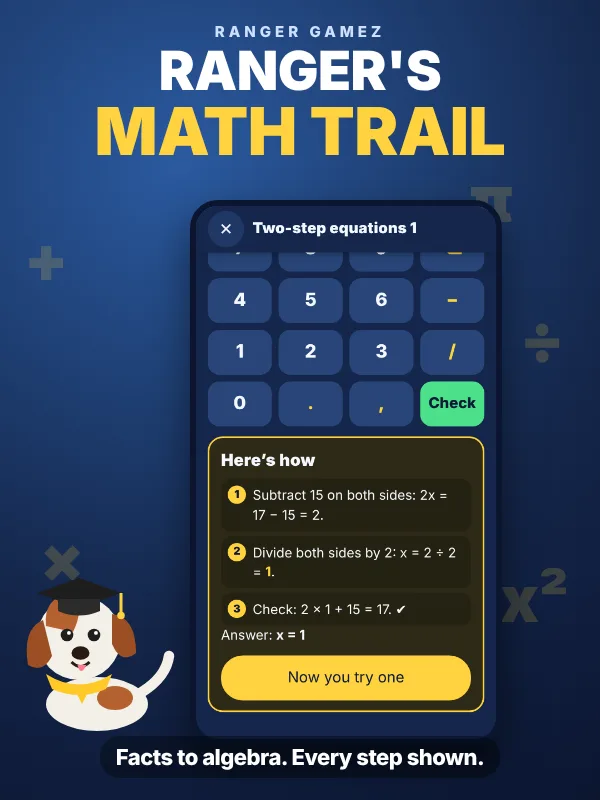
Free, no sign-up. The game asks your age once, then every answer comes with a hint and a step-by-step Show me how.
How to do it
- Line up the decimal points, one under the other.
- Fill empty places with zeros so both numbers have the same number of digits after the point.
- Add or subtract as if they were whole numbers.
- Put the point back in the same place. To turn a fraction into a decimal, divide the top by the bottom.
Worked examples
Example 18.51 − 1.99 = ?
- Line up the decimal points (add zeros so both have 2 digits after the point).
- Subtract as if they were whole numbers: 851 − 199 = 652.
- Put the point back, 2 places from the right: 6.52.
Answer: 6.52
Try one like it →Example 2Write 7/20 as a decimal.
- The fraction bar means divide: 7 ÷ 20.
- Or make the bottom 100: 7/20 = 35/100.
- So 7/20 = 0.35.
Answer: 0.35
Try one like it →Mistakes to watch for
- Lining up the last digits instead of the points is the classic mistake: 4.5 + 1.25 is 5.75, not 1.70.
- A fraction with 10, 100 or 1,000 on the bottom is easy: 37/100 = 0.37.
The game
Questions
Do I need to type the zero before the point?
No. The game accepts .5 and 0.5, and 2.50 is the same as 2.5.
What age is it for?
Decimals usually start around age 10 (grade 4 or 5).
More math practice: Addition · Subtraction · Multiplication facts · Division and long division · Place value and rounding · Fractions · Percents and ratios · Negative numbers · Order of operations · Exponents and square roots · Solving equations · Slope and linear equations · Systems of equations · Factoring quadratics · Area, perimeter and volume · Angles · Pythagorean theorem · Circles · Mean, median, mode and range · All math topics