 RANGER
Math practice · Data · ages 10+
Free mean, median, mode and range practice
The Stats Kennel world in Ranger's Math Trail practices the four ways to sum up a list of numbers: the mean (average), the median (middle), the mode (most common) and the range (spread).
The data sets are short (5 to 8 numbers) so you can work them out in your head, and every answer sorts the numbers first so you can see the middle.
Practice mean, median, mode and range now
Pick a level
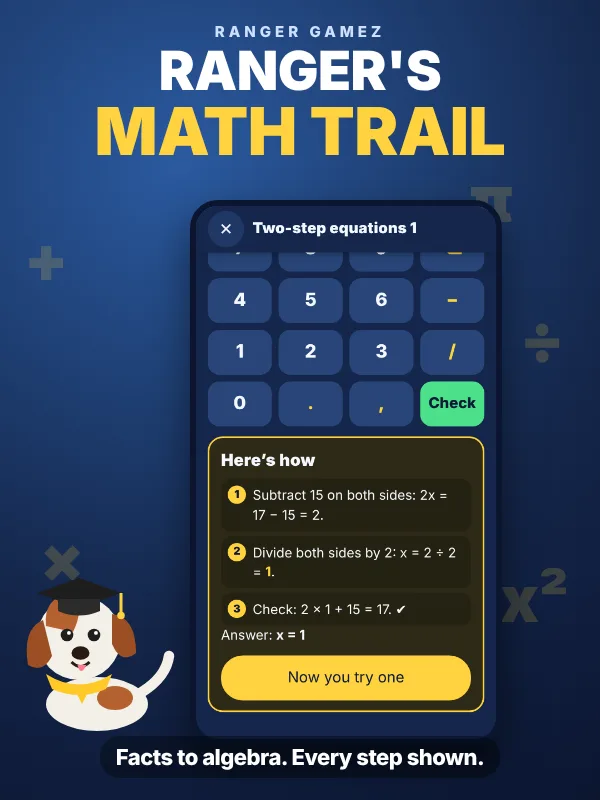
Free, no sign-up. The game asks your age once, then every answer comes with a hint and a step-by-step Show me how.
How to do it
- Mean: add all the numbers, then divide by how many there are.
- Median: sort the numbers and take the middle one. With an even count, take halfway between the two middle numbers.
- Mode: the number that appears most often.
- Range: the biggest number minus the smallest.
Worked examples
Example 1Barks heard each hour: 15, 2, 16, 10, 10, 4, 6. What is the mean?
- Mean = add them all up, then divide by how many there are.
- Sum: 15 + 2 + 16 + 10 + 10 + 4 + 6 = 63.
- There are 7 numbers: 63 ÷ 7 = 9.
Answer: 9
Try one like it →Example 2Treats eaten each day: 2, 5, 11, 14, 20, 2, 5, 13. What is the median?
- Put them in order: 2, 2, 5, 5, 11, 13, 14, 20.
- There are two middle numbers, 5 and 11. Take the halfway point: (5 + 11) ÷ 2 = 8.
Answer: 8
Try one like it →Mistakes to watch for
- Always sort before finding the median. The middle of an unsorted list means nothing.
- The median of an even count can be a half, like 7.5.
The game
Questions
Is the mean the same as the average?
Yes. When people say average, they usually mean the mean.
What age is it for?
Usually grades 5 to 6 (ages 10 to 12).
More math practice: Addition · Subtraction · Multiplication facts · Division and long division · Place value and rounding · Fractions · Decimals · Percents and ratios · Negative numbers · Order of operations · Exponents and square roots · Solving equations · Slope and linear equations · Systems of equations · Factoring quadratics · Area, perimeter and volume · Angles · Pythagorean theorem · Circles · All math topics