 RANGER
Math practice · Geometry · ages 13+
Free Pythagorean theorem practice
In any right triangle, the two short sides (legs) and the long side (hypotenuse) follow a² + b² = c². Ranger's Math Trail practices finding the hypotenuse first, then finding a missing leg.
Every triangle is a whole-number one (like 3-4-5 or 5-12-13 and their multiples), so you can do it without a calculator.
Practice pythagorean theorem now
Pick a level
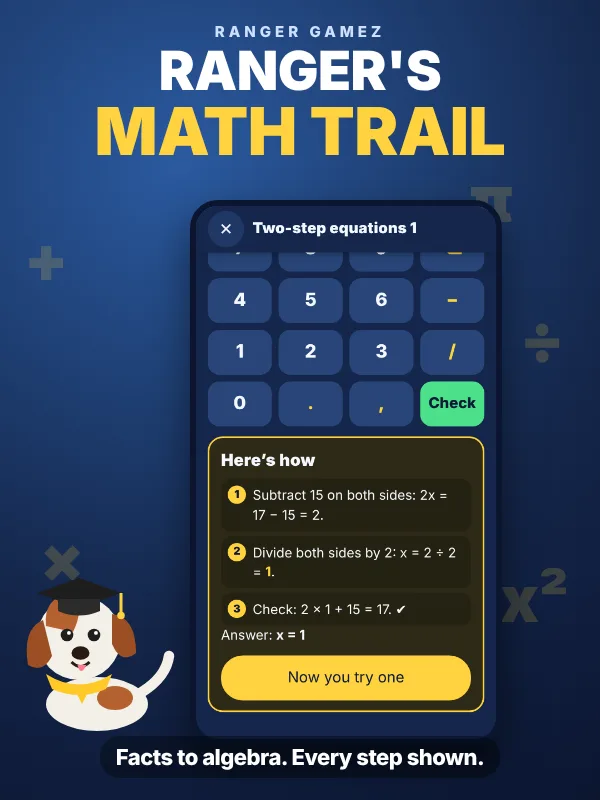
Free, no sign-up. The game asks your age once, then every answer comes with a hint and a step-by-step Show me how.
How to do it
- Label the sides: a and b are the legs; c is the hypotenuse, across from the right angle.
- To find c: square a and b, add them, then take the square root.
- To find a leg: square c and the leg you know, subtract, then take the square root.
- Check: the hypotenuse is always the longest side.
Worked examples
Example 1A right triangle has legs 7 and 24. How long is the longest side (hypotenuse)?
- For a right triangle: a² + b² = c² (c is the side across from the square corner).
- 7² + 24² = 49 + 576 = 625.
- c = √625 = 25.
Answer: 25
Try one like it →Example 2A right triangle has a hypotenuse of 25 and one leg of 7. How long is the other leg?
- a² + b² = c², so b² = c² − a².
- 25² − 7² = 625 − 49 = 576.
- b = √576 = 24.
Answer: 24
Try one like it →Mistakes to watch for
- Square before adding. 3 + 4 = 7 is not the hypotenuse; √(9 + 16) = 5 is.
- Knowing the common triples (3-4-5, 5-12-13, 8-15-17, 7-24-25) saves time.
The game
Questions
Does it work for every triangle?
No. a² + b² = c² is only true for right triangles (with a 90° corner).
What age is it for?
It's usually taught in grade 8 (ages 13 to 14).
More math practice: Addition · Subtraction · Multiplication facts · Division and long division · Place value and rounding · Fractions · Decimals · Percents and ratios · Negative numbers · Order of operations · Exponents and square roots · Solving equations · Slope and linear equations · Systems of equations · Factoring quadratics · Area, perimeter and volume · Angles · Circles · Mean, median, mode and range · All math topics