 RANGER
Math practice · Quick facts · ages 5+
Free subtraction practice, including borrowing
Subtraction in Ranger's Math Trail starts with taking away from 10, then 20, then moves to bigger numbers where you need to borrow (also called regrouping).
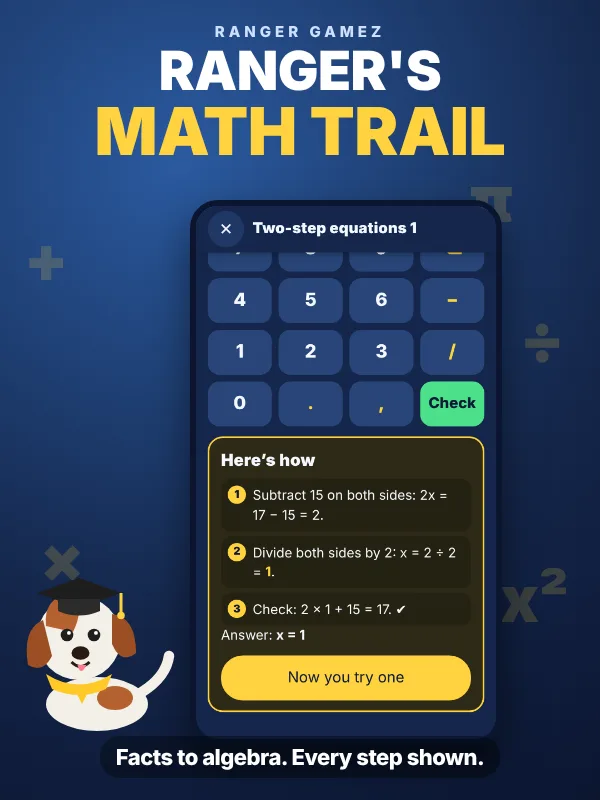
When you miss one, the game shows the answer and how to get it: a jump back on a number line for small facts, or each column with its borrow for big ones. Then you can try one like it.
Pick a level
Free, no sign-up. The game asks your age once, then every answer comes with a hint and a step-by-step Show me how.
How to do it
- For small facts, count back from the bigger number, or count up from the smaller one to the bigger one.
- For big numbers, line them up by place value and start with the ones column.
- If the top digit is smaller than the bottom digit, borrow 1 from the next column: the top digit gets 10 more, and the next column's top digit goes down by 1.
- Check your answer by adding it back: answer + the number you took away = the number you started with.
Worked examples
Example 119 − 6 = ?
- Think of it as a jump back: start at 19 and go back 6.
- Or count UP from 6 to 19: that is 13 steps.
- 19 − 6 = 13. Check: 6 + 13 = 19. ✔
Answer: 13
Try one like it →Example 256 − 34 = ?
- Line the numbers up by place value, then subtract each column from the right.
- Ones: 6 − 4 = 2.
- Tens: 5 − 3 = 2.
- 56 − 34 = 22. Check: 34 + 22 = 56. ✔
Answer: 22
Try one like it →Mistakes to watch for
- Counting up is often easier: for 13 − 8, count from 8 to 13. That's 5.
- Never subtract the smaller digit from the bigger one when it's on the bottom (for 42 − 17, the ones column is not 7 − 2). Borrow instead.
- When the next column is 0, you borrow from the column after it first.
The game
Questions
What is borrowing in subtraction?
When a top digit is too small to take the bottom digit away, you take 1 from the next place to the left, which is worth 10 in this place. Schools also call it regrouping.
What age is it for?
About ages 5 to 9. Set your age when you start and the game picks the right size of numbers.
More math practice: Addition · Multiplication facts · Division and long division · Place value and rounding · Fractions · Decimals · Percents and ratios · Negative numbers · Order of operations · Exponents and square roots · Solving equations · Slope and linear equations · Systems of equations · Factoring quadratics · Area, perimeter and volume · Angles · Pythagorean theorem · Circles · Mean, median, mode and range · All math topics