 RANGER
Math practice · Pre-algebra · ages 10+
Free order of operations (PEMDAS) practice
Order of operations is the rule for which part of a sum to work out first. Ranger's Math Trail practices it in three levels: multiplying before adding, parentheses, then exponents mixed with multiplying and dividing.
Every answer is worked one operation at a time, in order, so you can see exactly where a different order gives a different answer.
Practice order of operations now
Pick a level
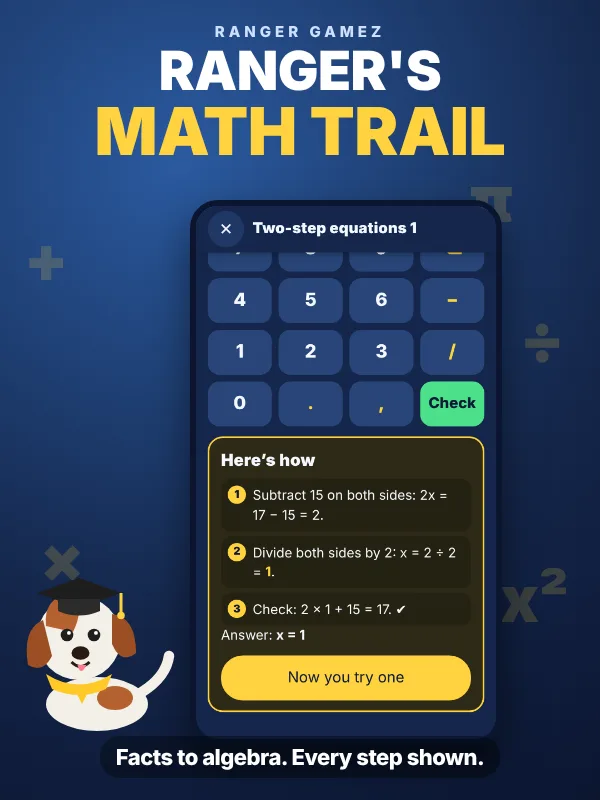
Free, no sign-up. The game asks your age once, then every answer comes with a hint and a step-by-step Show me how.
How to do it
- Parentheses first.
- Then exponents (powers like 3²).
- Then multiply and divide, working left to right.
- Then add and subtract, working left to right.
Worked examples
Example 1(9 + 3) × 3 − 1 = ?
- Parentheses first: 9 + 3 = 12.
- Multiply: 12 × 3 = 36.
- Subtract: 36 − 1 = 35.
Answer: 35
Try one like it →Example 217 + 22 × 5 − 10 ÷ 2 = ?
- Exponent first: 22 = 2 × 2 = 4.
- Multiply and divide, left to right: 4 × 5 = 20, and 10 ÷ 2 = 5.
- Add and subtract, left to right: 17 + 20 − 5 = 32.
Answer: 32
Try one like it →Mistakes to watch for
- PEMDAS can mislead: multiplying doesn't always come before dividing. They share a step and go left to right. The same goes for adding and subtracting.
- In 2 + 3 × 4, multiply first: 2 + 12 = 14, not 20.
The game
Questions
What does PEMDAS stand for?
Parentheses, Exponents, Multiplication and Division (left to right), Addition and Subtraction (left to right). Some schools say BODMAS or BIDMAS; it's the same order.
What age is it for?
Usually grades 5 to 6 (ages 10 to 12).
More math practice: Addition · Subtraction · Multiplication facts · Division and long division · Place value and rounding · Fractions · Decimals · Percents and ratios · Negative numbers · Exponents and square roots · Solving equations · Slope and linear equations · Systems of equations · Factoring quadratics · Area, perimeter and volume · Angles · Pythagorean theorem · Circles · Mean, median, mode and range · All math topics